Wednesday, June 05, 2019

The Man Who Told America the Truth About D-Day


The Man Who Told America the Truth About D-Day


By David Chrisinger
NY Times

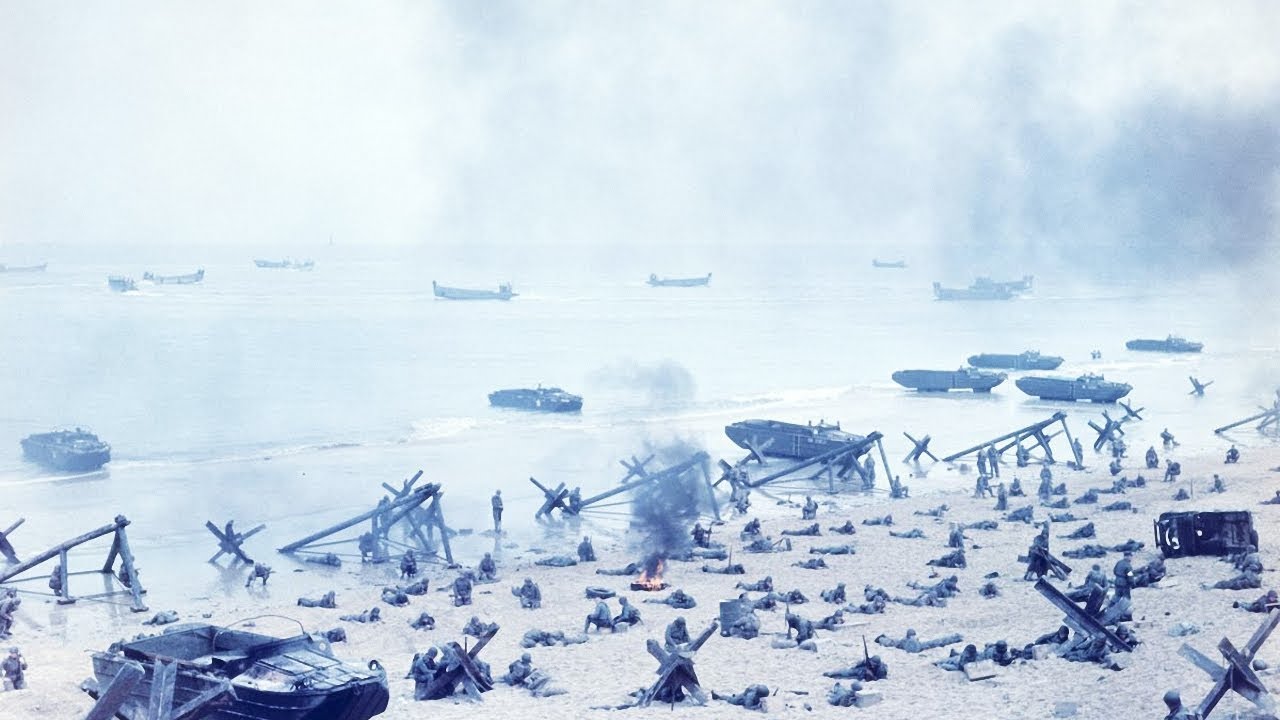
Most of the men in the first wave never stood a chance.In the predawn darkness of June 6, 1944, thousands of American soldiers crawled down swaying cargo nets and thudded into steel landing craft bound for the Normandy coast. Their senses were soon choked with the smells of wet canvas gear, seawater and acrid clouds of powder from the huge naval guns firing just over their heads. As the landing craft drew close to shore, the deafening roar stopped, quickly replaced by German artillery rounds crashing into the water all around them. The flesh under the men’s sea-soaked uniforms prickled. They waited, like trapped mice, barely daring to breathe. 

A blanket of smoke hid the heavily defended bluffs above the strip of sand code-named Omaha Beach. Concentrated in concrete pill boxes, nearly 2,000 German defenders lay in wait. The landing ramps slapped down into the surf, and a catastrophic hail of gunfire erupted from the bluffs. The ensuing slaughter was merciless. 

But Allied troops kept landing, wave after wave, and by midday they had crossed the 300 yards of sandy killing ground, scaled the bluffs and overpowered the German defenses. By the end of the day, the beaches had been secured and the heaviest fighting had moved at least a mile inland. In the biggest and most complicated amphibious operation in military history, it wasn’t bombs, artillery or tanks that overwhelmed the Germans; it was men — many of them boys, really — slogging up the beaches and crawling over the corpses of their friends that won the Allies a toehold at the western edge of Europe. 

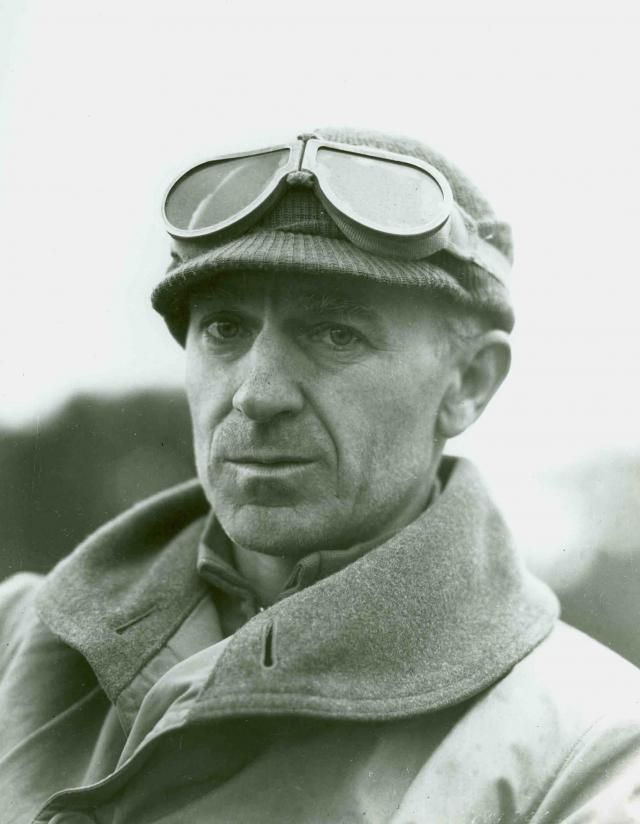
That victory was a decisive leap toward defeating Hitler’s Germany and winning the Second World War. It also changed the way America’s most famous and beloved war correspondent reported what he saw. In June 1944, Ernie Pyle, a 43-year-old journalist from rural Indiana, was as ubiquitous in the everyday lives of millions of Americans as Walter Cronkite would be during the Vietnam War. What Pyle witnessed on the Normandy coast triggered a sort of journalistic conversion for him: Soon his readers — a broad section of the American public — were digesting columns that brought them more of the war’s pain, costs and losses. Before D-Day, Pyle’s dispatches from the front were full of gritty details of the troops’ daily struggles but served up with healthy doses of optimism and a reliable habit of looking away from the more horrifying aspects of war. Pyle was not a propagandist, but his columns seemed to offer the reader an unspoken agreement that they would not have to look too closely at the deaths, blood and corpses that are the reality of battle. Later, Pyle was more stark and honest. 

For days after the landing, no one back home in the States had any real sense of what was happening, how the invasion was progressing or how many Americans were being killed. 

Nearly impossible to imagine today, there were no photographs flashed instantly to the news media. No more than 30 reporters were allowed to cover the initial assault. The few who landed with the troops were hampered by the danger and chaos of battle, and then by censorship and long delays in wire transmission. The first newspaper articles were all based on military news releases written by officers sitting in London. It wasn’t until Pyle’s first dispatch was published that many Americans started to get a sense of the vast scale and devastating costs of the D-Day invasion, chronicled for them by a reporter who had already won their trust and affection. 

Before World War II, Pyle spent five years crisscrossing the United States — and much of the Western Hemisphere — in trains, planes and a Dodge convertible coupe with his wife, Jerry, reporting on the ordinary people he met in his travels. He wrote daily, and his columns, enough to fill volumes, were syndicated for publication in local papers around the country. These weren’t hard-news articles; they were human-interest stories that chronicled Americans during the Great Depression. Pyle told stories about life on the road, little oddities and small, heart-lifting triumphs and the misery that afflicted the drought-stricken Dust Bowl regions of the Great Plains. 

Pyle honed a sincere and colloquial style of writing that made readers feel as if they were listening to a good friend share an insight or something he noticed that day. When the United States entered World War II, Pyle took that same technique — familiar, open, attuned to the daily struggles of ordinary people — and applied it to covering battles and bombings. Venturing overseas with American forces in 1942, Pyle reported the war through the eyes of the regular infantrymen on the front lines. He wrote about the food, the weather and the despair of living in slit trenches during the rainy late winter of 1943. He asked the soldiers their names and their hometown addresses, which he routinely included in his articles. Soon millions of readers were following Pyle’s daily column in about 400 daily and 300 weekly newspapers across the United States. In May 1944, Pyle was notified that he had been awarded the Pulitzer Prize for his dispatches. 

On D-Day, as the invasion force fought for the beach, Pyle was trapped just offshore, on a ship transporting tanks. He had boarded with a kit bag heavy with liquor bottles, some good-luck talismans and a Remington portable typewriter. As eager as he was to witness the landing, Pyle wasn’t allowed to go ashore at Omaha Beach until the morning after. For a couple of hours that day, he walked alone on the beach, along the ragged line where the ocean meets the sand, with his eyes trained downward. Weighing just over 100 pounds, Pyle resembled “a short scarecrow with too much feet,” as one Army historian described him.

Puffing on cigarettes and probably drinking a fair amount, Pyle spent the following days pecking away on his typewriter. His readers needed his words to make sense of what “our boys” were enduring in France. After he had written enough material for a few columns, he wondered if his plain-spoken prose would be enough to help anyone back home understand what it was to be contaminated with so much death. 

Pyle’s first column about the D-Day landings, published on June 12, 1944, gave his readers an honest accounting of how daunting the invasion had been — and what a miracle it was that the Allies had taken the beaches at all. “The advantages were all theirs,” Pyle said of the German defenders: concrete gun emplacements and hidden machine-gun nests “with crossfire taking in every inch of the beach,” immense V-shaped ditches, buried mines, barbed wire, “whole fields of evil devices under the water to catch our boats” and “four men on shore for every three men we had approaching the shore.” “And yet,” Pyle concluded, “we got on.” 

Pyle’s intent with this first column seems to have been simple: to elicit appreciation for the huge achievement and gratitude for “those both dead and alive” who had clawed their way up the beaches and taken down the enemy. 

This kind of dispatch was well-trod ground for Pyle, whose wartime columns tended to omit certain facts on the ground and reassure readers back home that the Allies were on the path to eventual victory. Tell the truth of it but offer reassurance too. Pyle used this same strategy when he began covering the war in 1940, and it served him well when he followed inexperienced American troops into ground combat in North Africa in 1942 and 1943, only to see them battered by the German army. After 1,600 men were killed or wounded by Germans in a trap at Sidi bou Zid in Tunisia, Pyle described the withdrawal of the remaining American forces as “a majestic thing.” Describing the fast-moving convoys of trucks and tanks, he wrote, “it was carried out so calmly and methodically” that it “was hard to realize, being a part of it, that it was a retreat.” He didn’t mention the 100 American tanks that were destroyed, or the loss in confidence the rank-and-file soldiers were feeling toward their command. Though he didn’t entirely whitewash the American defeat, which he called “damned humiliating,” Pyle’s artful narrative lent purpose and dignity to events that perhaps should have been probed more critically. 

Pyle’s second report from the Normandy beaches, published 10 days after D-Day, was markedly different from anything he had ever previously filed. “It was a lovely day for strolling along the seashore,” he wrote, reeling the reader in with a cheerful opening. “Men were sleeping on the sand, some of them sleeping forever. Men were floating in the water, but they didn’t know they were in the water, for they were dead.” Pyle cataloged the vast wreckage of military materiel, the “scores of tanks and trucks and boats” resting at the bottom of the Channel, jeeps “burned to a dull gray” and half-tracks blasted “into a shambles by a single shell hit.” Some reassurances followed to soften the unvarnished fact — the losses were an acceptable price for the victory, Pyle said — but he hadn’t shied away from showing his readers the corpses and “the awful waste and destruction of war.” Pyle was working up to something he hadn’t done before. 

The next day, June 17, newspapers across the country published Pyle’s third column describing the D-Day beachhead. By allowing the objects he saw in the sand to tell an eloquent story of loss, Pyle showed his readers the true cost of the fighting, without explicitly describing the blood and mangled bodies. “It extends in a thin little line, just like a high-water mark, for miles along the beach,” Pyle wrote about the detritus of the battle. “Here in a jumbled row for mile on mile are soldiers’ packs. Here are socks and shoe polish, sewing kits, diaries, Bibles and hand grenades. Here are the latest letters from home. . . . Here are toothbrushes and razors, and snapshots of families back home staring up at you from the sand. Here are pocketbooks, metal mirrors, extra trousers and bloody, abandoned shoes.” 

Pyle often included himself in his stories, addressing his readers directly and letting them see him in the scene, a reassuring presence who was keeping his eye on things for them, reducing sprawling events to their digestible essentials. But here Pyle depicted himself as stunned and confused — a dazed witness to gambles and losses on a scale that nobody could comprehend. “I picked up a pocket Bible with a soldier’s name in it, and put it in my jacket,” he wrote. “I carried it half a mile or so and then put it back down on the beach. I don’t know why I picked it up, or why I put it back down.” 

By the end of the column, Pyle’s readers were confronted with outright horror: “As I plowed out over the wet sand of the beach,” Pyle wrote, “I walked around what seemed to be a couple of pieces of driftwood sticking out of the sand. But they weren’t driftwood. They were a soldier’s two feet. He was completely covered by the shifting sands except for his feet. The toes of his G.I. shoes pointed toward the land he had come so far to see, and which he saw so briefly.” 

Omaha Beach had some of the fiercest fighting of the invasion. Pyle came ashore here the next day and walked alone on the beach. 

This was a different Ernie Pyle from the one millions of Americans knew from the newspapers that kept them company at the breakfast table or on the train home in the evening. If his reporting before D-Day was aimed at comforting the disturbed readers back home with optimism and tales of the soldiers’ endurance, his reporting from the beaches of Normandy was aimed at disturbing the comfortable. 

To his own surprise, his dispatches about D-Day’s losses were not met with rejection or censorship. In addition to the newspapers that ran his columns, Life magazine requested permission to run an excerpt, and radio programs quoted Pyle in commercials imploring listeners to buy war bonds. In Washington, two of the columns were reprinted in the official Congressional Record. “It’s getting so you can’t pick up any damned publication at all without seeing you mentioned,” Lee Miller, Pyle’s editor, wrote to the reporter on June 19, 1944. 

Until D-Day, war had largely been an exhilarating experience for Pyle, terrible but often uplifting. Ten days after the landings, the awfulness of all the death he was witnessing in the “thousands of little skirmishes” in the hedgerow country of Normandy was carving away at his mental state. He reported having knots in his stomach from “constant tenseness and lack of sleep.” In a letter back home, he confided that he had to “continually fight an inner depression over the ghastliness of it all.” “Sometimes,” he wrote to Miller on June 29, “I get so obsessed with the tragedy and horror of seeing dead men that I can hardly stand it. But I guess there’s nothing to do but keep going.” 

Less than two weeks after witnessing the jubilant liberation of Paris, Pyle wrote his final column from Europe. “I’m leaving,” he told his readers. “ ‘I’ve had it,’ as they say in the Army. I have had all I can take for a while.” After spending 29 months overseas, writing around 700,000 words about the war and surviving nearly a year at the front lines, Pyle confided that his spirit was faltering and confused. “I do hate terribly to leave right now, but I have given out,” he wrote. “I’ve been immersed in it too long. The hurt has finally become too great.” 

Pyle returned home to New Mexico. After a few months back in the United States, overwhelmed by mountains of mail, invasions of his privacy and his wife’s attempted suicide, Pyle’s dread of war was outweighed by his unease in civilian life. Life on the front line was simpler. Pyle missed it. Shortly before Christmas 1944, he began making final preparations to report to the Pacific, where American forces were “island hopping” their way toward Japan. 

The grim view of the war that overtook Pyle in Normandy — the sense that perhaps the losses were simply beyond bearing — seemed to follow Pyle to the Pacific, but it showed up differently in his reporting there. Interviewing bomber pilots on islands far from the fighting and sailors on Navy ships who seemed safe and comfortable compared with infantrymen on the front lines, Pyle felt that he was seeing a softer, easier war, and he let it show. “The days are warm and on our established island bases the food is good and the mail service is fast and there’s little danger from the enemy,” he wrote in a column titled “Europe This Is Not.” Worried that he wasn’t doing his part for the war effort, Pyle arranged to go with the Marines when they landed on Okinawa, where the fighting was expected to be intense. It was no D-Day — the Japanese had retreated inland, and Pyle was amazed to see a beach landing with no carnage — but the Marines soon found themselves mired in bitter fighting for every hill and cave. On April 18, 1945, 20 days before the war in Europe ended, Pyle was shot through the left temple by a Japanese machine-gunner and died instantly in a ditch on the tiny island of Ie Shima, off the northwest coast of Okinawa. 

“I’m leaving,” Pyle wrote in his final column from Europe. “I’ve had it, as they say. 

Before Pyle’s body was buried under a crude marker in the 77th Division’s cemetery, a draft of a column he was writing was discovered in his pocket. It was not so much a dispatch as it was a meditation on the end of the war. “Last summer,” Pyle said, “I wrote that I hoped the end of the war could be a gigantic relief, but not an elation. In the joyousness of high spirits it is so easy for us to forget the dead.” That was a relief that he knew was simply unavailable to many and a forgetting that shouldn’t be allowed to any. 

The draft went on: “There are so many of the living who have had burned into their brains forever the unnatural sight of cold dead men scattered over the hillsides and in the ditches. . . . Dead men in such familiar promiscuity that they become monotonous. Dead men in such monstrous infinity that you come almost to hate them. Those are the things that you at home need not even try to understand. To you at home they are columns of figures, or he is a near one who went away and just didn’t come back. You didn’t see him lying so grotesque and pasty beside the gravel road in France. We saw him, saw him by the multiple thousands. That’s the difference.” 

During his four years as a war correspondent, Pyle was embraced by enlisted men, officers and a huge civilian public as a voice who spoke for the common infantryman. With his trauma in France, he had become one of them. After sharing so much of their experience, he understood how gravely war can alter the people who have to see it and fight it and live it. He knew that the survivors can come home with damage that is profound, painful and long-lasting. It was a truth that he found hard or even impossible to communicate to the readers back home — and it is a truth that is still difficult and troubling now, 75 years after D-Day. 

We accept that our wars are different now — more scattered, seemingly never-ending, against a more diffuse and elusive enemy — but those wars are still presented with the promise that we are fighting for our way of life or the survival of our values, and that we’ll enjoy greater peace and security when those wars are won. War reporting has become more honest and unsparing about tallying the death toll — at least on our side — but politicians making the case for deployments and invasions still don’t invite the public in advance to decide whether the promised benefits will be worth the losses. 

Seeing and reporting the vast losses on the beach at Normandy and watching war’s meat grinder in action in the vicious battles that followed, Pyle was evidently forced to recalculate the arithmetic of victories and losses. By the time he was killed, 10 months later and on the opposite side of the world, the lesson seemed to have solidified for him. Not even the war ending, not even victory — which his previous reporting usually kept in sight as the great goal of the war — would be able to bring back all the people killed or counteract the damage done to the survivors. Pyle had written about battles and war in a way that promised hope. By the time victory was actually in sight, he had come to feel that there was no way the war could be a story with a happy ending.

Friday, May 24, 2019

‘Mean Girl’ Says to Thank Ayn Rand


Think We Live in Cruel and Ruthless Times? ‘Mean Girl’ Says to Thank Ayn Rand

By Jennifer Szalai NY Times


Ayn Rand liked to see herself as an ardent custodian of truth, but in her own life she had a hard time abiding too much reality. The critical recognition she craved mostly eluded her — her best-selling novels “The Fountainhead” (1943) and “Atlas Shrugged” (1957) were lurid, melodramatic, full of implausible characters and turgid harangues — and as her fame and notoriety grew, she retreated to the safe harbor of her acolytes.

Or presumably safe. As Lisa Duggan explains in “Mean Girl: Ayn Rand and the Culture of Greed,” when Rand’s affair with a much younger disciple soured in the late 1960s, her Objectivist movement — which venerated a single, knowable reality, rationally apprehended by gloriously self-interested individuals — seemed on the brink of collapse. “Emotion,” Duggan writes, “had brought down the house of reason.”

It’s the kind of strange, glaring paradox that makes Rand a useful emblem for our topsy-turvy moment, Duggan says. Rand’s simplistic reversals — selfishness is a virtue, altruism is a sin, capitalism is a deeply moral system that allows human freedom to flourish — have given her work a patina of transgression, making her beloved by those who consider themselves bold, anti-establishment truth tellers even while they cling to the prevailing hierarchical order. Not for nothing does her enormous fan base include Silicon Valley entrepreneurs, Tea Partiers, President Trump and innumerable adolescents.

But then her ideas are too rigid to be neatly amenable to any real-world programs. Duggan’s short book includes a long section on neoliberalism that seems, for a while, to lose sight of Rand. Despite her mentorship of Alan Greenspan, who would eventually become the chairman of the Federal Reserve, Rand was “not exactly a neoliberal herself,” Duggan writes. She also refused to support the election of Ronald Reagan, deriding him for succumbing to “the God, family, tradition swamp.” She was an atheist and a fierce advocate for abortion rights.

Now, almost four decades after Rand’s death in 1982, right-wing nationalism and evangelical Christianity are ascendant at the same time as economic globalization and the erosion of the welfare state. Is there anything that ties this turbulence together? Yes, Duggan says, but it isn’t the vaunted rationality that Rand fetishized as much as it is the feelings she validated. “The unifying threads are meanness and greed,” Duggan writes of the current moment, “and the spirit of the whole hodgepodge is Ayn Rand.”

Rand wasn’t an especially sophisticated thinker who delved into primary texts to elaborate her philosophical system; she did, however, have a flair for the dramatic. One of her first jobs after emigrating from the Soviet Union to the United States in 1926 was as a scriptwriter for Cecil B. DeMille. She brought that theatrical sensibility to novels like “The Fountainhead,” which, in Duggan’s astute appraisal, offers “numerous plot twists but no real surprises.” In both “The Fountainhead” and “Atlas Shrugged,” Rand strenuously played to the aspirations and desires of her readers. “Ayn Rand made acquisitive capitalists sexy,” Duggan writes. The novels “are conversion machines that run on lust.”

As befitting machines, the novels seem less literary than en
gineered. The Randian heroine is a Mean Girl — tall, svelte, severe. The Randian hero is a Mean Boy — tall, muscular, severe. Her villains are short and doughy, cursed with receding chins and dandruff. The undeserving weak exploit the worthy and the strong. The United States she depicts is ahistoric and sanitized for her readers’ consumption — “a clean slate for pure capitalist freedom, with no indigenous people, no slaves, no exploited immigrants or workers in sight,” Duggan writes. In “The Fountainhead” and “Atlas Shrugged” there’s certainly sex but no pregnancies; nothing that might interfere with all the creative destruction her characters have to do.

Duggan, a professor of social and cultural analysis at New York University and the author of previous books about gender, sexuality and cultural politics, says that her “weird obsession with Ayn Rand began many years ago.” She calls “Atlas Shrugged” “heavy-handed, hectoring, relentless,” but allows that it is “also iconoclastic, sometimes surprising and even occasionally funny.”


What seems to fascinate Duggan most is how Rand — with her unyielding worldview, her extreme, sweeping statements and her intolerance of dissent — has somehow managed to be reclaimed by those she so cruelly deplored. Rand described homosexuality as “immoral” and “disgusting,” yet her “rages against the strictures of family, church and state appeal to many L.G.B.T.Q. readers.” The younger generation of libertarians who approvingly cite Rand today might be surprised to learn that she derided their forebears as “hippies” and, with typical hyperbole, “a monstrous, disgusting bunch of people.

But this is what happens when you devise a philosophical system in which every human relationship is transactional: Before you know it, you’ll get co-opted and commodified too.

Duggan paints Rand as cynical and shrewd in some ways, and hapless and naïve in others. In 1947, Rand volunteered to appear before the House Un-American Activities Committee as a friendly witness, delivering histrionic testimony that managed to alienate everyone, suggesting that she “never fully grasped” how Hollywood worked, or how government worked, or how the balance of power worked between the two. She liked to affect a steely, imperious persona, but she was deeply insecure and easily wounded. She developed a debilitating amphetamine habit. Her fictional heroes marched forth and conquered life, but real life kept throwing her for a loop.

Rand was most successful as a fantasist and “propagandist,” Duggan writes, who provided “templates, plot lines and characters” that gave selfishness an alluring sheen. In Rand’s universe, capitalism was glamorous and liberating, with none of the mundane concerns — haggling over health insurance, paying off student loans, scrambling for child care, managing precarious employment — that consume so much of everyday American experience.

Reading Duggan on Rand’s current fans made me think of the 1946 preface to Rand’s early novel “Anthem,” in which she railed against “the people who support plans specifically designed to achieve serfdom, but hide behind the empty assertion that they are lovers of freedom.” Surveying the wreckage, such people expect “to escape moral responsibility by wailing: ‘But I didn’t mean this!’”

Tuesday, May 14, 2019

A Hip Sex Goddess


Doris Day: A Hip Sex Goddess Disguised as the Girl Next Door


By A.O. Scott The New York Times

The Hollywood Reporter obituary for Doris Day describes her in the headline as “Hollywood’s Favorite Girl Next Door,” which is reasonable enough, if not terribly imaginative. Day, who was 97 when she died on Monday, broke through as a singer in the mid-1940s and crossed over into movie stardom in the next decade. She’s still often remembered as an avatar of the postwar, pre-counterculture pop culture mainstream: wholesome, friendly, sexless. Accordingly, the first adjective applied to her in that article’s summary is “virginal.”

That word evokes a leering one-liner attributed to the musician and wit Oscar Levant, who said he “knew Doris Day before she was a virgin.” Levant’s joke depends on a category mistake, confusing the persona of a star with her person (Day was married three times), even as it misses the joke tucked into the persona itself. The v-word applied to Day signals the acceptance of an alibi that was never meant to be believed in the first place, the literal-minded gloss on a text that was only there to beckon us toward the subtext.

The truth, hidden in plain sight in so many of her movies and musical performances, is that Doris Day was a sex goddess. That’s not a term we use much anymore (for good reason), and in its heyday it was generally applied to actresses who wielded their erotic energies more nakedly, so to speak.

Day wasn’t a glamorous blond enigma like Grace Kelly or Kim Novak — though she did, like both of them, work with Alfred Hitchcock. She was not a Hollywood bombshell in the manner of Marilyn Monroe (or Mamie Van Doren, with whom she competed for Clark Gable’s attention in the 1958 comedy “Teacher’s Pet”). And she certainly didn’t work in the same erogenous zone as European actresses like Brigitte Bardot and Sophia Loren, who promised sophisticated American moviegoers a glimpse of freedom from Puritanical inhibition, and sometimes also from clothes.

But it’s too easy to say that Day was simply the opposite — the prim, prudish, all-American avatar of Eisenhower-era repression, with her hair in a neat chignon and her figure sheathed in a soberly tailored suit. To see her that way is to take at face value an archetype that she did everything in her formidable power to subvert.

Really, though, the whole virgin thing doesn’t even rise to the level of archetype. It’s an artifact of a movie censorship system that was, in the years after the Kinsey Report, rapidly losing touch with the realities of American behavior, and with the rest of popular culture as well.

In the canonical romantic comedies she made with Rock Hudson — “Pillow Talk” and “Lover Come Back” two years later — Day, in her late 30s, played unmarried New York career women.

Jan Morrow in “Pillow Talk” is an interior designer with a thriving, if hectic, business. Her counterpart in “Lover Come Back,” Carol Templeton, is a high-ranking executive in a Manhattan advertising firm. They are (implicitly) virgins by fiat of the production code, but really it’s up to the audience to decide how credible it is that neither one has managed to sleep with anyone until Hudson shows up. (When Hudson and Day reunited for “Send Me No Flowers” in 1964, they were playing husband and wife, and it wasn’t as much fun.)

The simple, sexist premise of these movies — and also of“Teacher’s Pet,” in which Day’s uptight professor is seduced by Gable, her most unlikely student — is that Day needs a raffish he-man to come along and ruffle her feathers with his sheer masculine irresistibility, getting her into bed with the benefit of clergy. But that pursuit is played out by means of a plot that relishes its own ridiculousness. The color schemes and production designs in the Hudson-Day comedies pulsate with whimsy. The atmosphere is pure camp, of the zany rather than the melodramatic variety. Every line sounds like a double-entendre. Every encounter is full of implication and innuendo, every character a collection of mixed signals.

These movies are naughty beyond imagining, and as clean as a whistle. In “Pillow Talk” — in effect the first movie about the pleasures and consequences of phone sex — Hudson and Day take a bath together. It’s a split-screen shot, but still.

The plot of “Lover Come Back” turns on the mass marketing of a powerful, possibly hallucinogenic drug. Heterosexual courtship under the mandate of matrimony has rarely looked so kinky. We’re not even talking about what it means that Rock Hudson is the male lead. The ambiguity is ambient. The deniability is perfect, and perfectly preposterous.

Day is the key to it all, because her presence simultaneously upholds the pretense of virtuous normality and utterly transgresses it. She is a walking semiotic riot with a pert nose and a winning smile, keeper and scrambler of a whole book of social norms and cultural codes.

To see what I mean, consider a scene from “Pillow Talk” in which Jan takes Brad Allen (Hudson’s playboy classical-music composer) to a nightclub. It’s maybe daring for his square sensibilities, which is to say that the music is being performed by black people. (The clientele is all white.) It turns out that his date is familiar with the musicians, and the music. Midway through a song called “Roly Poly,” the pianist and singer (Perry Blackwell) invites Jan to take a verse — “come on Miss Morrow, you know this one” — and pretty soon Brad is clapping along. By the chorus, he and Jan are playing patty cake, and pretty soon the whole joint is singing about the satisfactions of a lover who is built for comfort rather than for speed.

It’s impossible not to interpret this number as a cringe-inducing spectacle of cultural appropriation, pushed to and past the point of parody. The sexual and racial undercurrents eddy and swirl under a surface of pure silliness. In old Hollywood movies, African-American music is a complicated signifier, not least for the white characters who appreciate it. In not-so-old movies, too. When, for example, Ryan Gosling takes Emma Stone to listen to jazz in “La La Land,” he is telling her, and us, something about the kind of guy he is. He’s claiming access to, and a share of, what the music represents. Passion. Authenticity. Sex, too, of course.

In 1959, one name for this transaction — which might look from one angle like a gesture of respect, from another like an act of brazen existential plunder — was “hip.” It was a noun as much as an adjective, and it was not a word that anyone would have thought to apply to Doris Day. Partly because she was too canny to take it seriously, notwithstanding her serious interest in African-American music.

In “Love Me or Leave Me,” a show-business biopic from 1955, she performs a version of Irving Berlin’s “Shaking the Blues Away,” wearing a low-cut bright-blue gown slit up to her thigh. The lyric’s absurd evocation of religious revivals “way down South” gives way to a stage full of male chorines in top hats and tails, as Day belts out a paean to dancing that is a rollicking celebration of … something else. She’s singing the language of rock ’n’ roll at the moment of rock ’n’ roll’s emergence, but what she’s doing is … something else. She’s messing with all our categories. Which was her great and underappreciated gift.

Monday, April 29, 2019

Turf Wars, Songbird-Style


Turf Wars, Songbird-Style

In springtime, everything in nature loves a wall. 

By Margaret Renkl NY Times
Contributing Opinion Writer


NASHVILLE — I was eating lunch on our front stoop last week when a flock of European starlings descended all at once, covering our yard in a commotion of strutting and whistling and picking and whirring. The spring wildflowers were all bloomed out, nothing left but greenery, so my husband had mowed the meadow in front of our house into some semblance of a suburban lawn. A freshly mowed yard means fewer places for insects to hide, and the starlings got busy gleaning and digging.

I am no fan of European starlings. I would like European starlings just fine if they had stayed in Europe, but some foolish Shakespeare aficionados, determined to introduce into this country every bird ever mentioned in Shakespeare, released 100 starlings in New York City’s Central Park during the 19th century. The more than 200 million starlings in North America today descended from those first 100 birds.

Starlings compete for nesting cavities with native cavity-dwellers: bluebirds and tree swallows, woodpeckers and chickadees, wood ducks and tufted titmice. There’s a pair nesting in a woodpecker’s hole in a tree in front of my neighbor’s house, and three pairs nesting in the hollow window frames of another neighbor’s house. Every time I pass by them, I glower out of nothing but old habit. A 2003 study disputed long-held assumptions that starlings displace native birds. “Only sapsuckers showed declines due to starlings,” according to the Cornell Lab of Ornithology; “other species appeared to be holding their own against the invaders.” But long-held assumptions are hard habits to break, and I have never warmed to these gregarious birds.

The bluebirds that have chosen the nest box in our front yard share my dislike. The male bluebird set up an angry clicking from his perch in a nearby maple as soon as the flock landed in our yard, and when one of them had the nerve to peer into the nest-box hole — which is, by design, too small to admit a starling — he immediately dived at the intruder’s head, startling it so thoroughly that it fell to the ground before it could stop its headlong tumble and fly away.

The rest of the starlings were unperturbed by this spectacle, but the female bluebird inside the box was drawn to the fray, peeking out of the hole of the nest box as her mate staged unceasing guerrilla raids on the intruders from a low-hanging branch in his lookout tree.

As soon as a starling bent to stab its bill into the soil, the male bluebird hit it in the head from above and was gone again before it could discern the source of its torment. Divebombing one starling after another, the bluebird carried on his relentless territorial campaign. Finally, through no signal that I could discern, the starlings lifted as one and disappeared into the sky. The bluebird, badly outnumbered by larger birds, had successfully driven them all away.

Matters always get tense during nesting season. “The dawn chorus” is what we call the springtime music that fills the trees at break of day this time of year, but it is nothing like a human chorus. Birds sing to attract a mate, and they sing to establish territory. And that territorialism is deadly serious.

While the bluebird was successfully repelling the flock of starlings, I later discovered, a tiny house wren was pulling all the moss and all the speckled eggs out of the nest box on the other side of the house. Instead of a chickadee’s mossy nest, that box now holds a house wren’s nest of sticks. Audubon still lists Tennessee as uncommon breeding territory for house wrens, but they have nested in our yard for at least five years. Every year they wreak havoc on the chickadees, and often on the bluebirds, too.

I can hardly fault them for doing exactly what the bluebirds are doing: staking out a claim and defending it against encroachers. I tell myself, too, not to fault the red-bellied woodpecker, which this year has taken an inexplicable interest in my safflower feeder, for driving away the rose-breasted grosbeaks that have finally arrived here on their long migration north. I wait for the grosbeaks every spring, and I buy that expensive safflower seed for two reasons: 1) starlings don’t like it, and 2) grosbeaks do. And now this furious woodpecker keeps driving them away.

I can’t help thinking about these avian territorial disputes every time the president of the United States weighs in on the subject of immigration. The president is determined to “defend our border,” as though we were under some kind of military siege, never mind that the boundary he’s so eager to defend was established by actual bloodshed — the blood of human beings who were here first.

Just as there are enough insects in my yard for both starlings and bluebirds, enough safflower seeds for both the local birds and the wayfaring strangers, there is plenty of room in this country for the people who already live here, as well as for the refugees who are desperate to come in, but the president’s base doesn’t believe that. Those poorer voters — whose anti-immigrant anger is energetically encouraged and exploited by the president’s wealthy constituents — are still howling, “Build that wall!” even as they continue to vote for politicians whose policies add to their own impoverishment — suppressing wages, gutting public schools, blocking access to health care, increasing gun violence, poisoning the places where they live.

Nevertheless, they direct their anger outward. Every newcomer is an alien competing for resources, and resources are already hard enough to come by in their own lives.

This is an argument from analogy, of course, and arguments from analogy inevitably falter because they’re reductive: The analogues are never perfectly equivalent. Human beings aren’t birds. We are capable of understanding and accepting logical arguments. We are capable of acting on moral and ethical imperatives. But springtime is a reminder that we — all of us, liberals and conservatives alike — are also creatures subject to the same atavistic impulses that drive the natural world. And when it seems as though there’s not enough to go around, nature will always have the upper hand.

Tuesday, April 23, 2019

Emma Goldman’s Bookshelf


Emma Goldman’s Bookshelf

By Candace Falk as told to Cori Brosnahan (PBS)
Bombing-Wall-Street-IdealBookshelf1048-EmmaGoldman.jpg


 To understand the people who've profoundly impacted history, we're exploring the books that profoundly impacted them. Here, Candace Falk, founding director of the Emma Goldman Papers research project at the University of California, Berkeley, tells us about the anarchist thinker's interest in edgy literature, passion for European plays, and deep study of the writers who shaped the U.S. Constitution. 

You might be surprised to know that a lot of what influenced Emma was literature. When she was young in Russia, she read this novel by Chernyshevsky called What Is to Be Done?  — Lenin actually took that title for a pamphlet he wrote later. But Chernyshevsky’s novel was about cooperative living, about people who lived together who weren’t married, who shared their money, who had interchangeable partners within their household. And this was an inspiration to Emma as a vision of another way to live. That Chernyshevsky novel was high on the list of the things she read and cared about.

Then, when she came to the U.S., she just read endlessly. At first in Russian, German, and Yiddish, and progressively more in English. She was so interested in being modern, being cutting edge. She was always going on to the next thing. There were some novels like Comrade Yetta that she liked because it was about a Jewish immigrant who came to New York. Emma identified with the immigrant experience. She never denied her Jewish roots, and actually attributed her perseverance to the perseverance of her people. But I do think she had a little bit of an aversion to all who only stuck to their own culture.

Various people who worked with her — anarchists from Austria, Germany, or Russia — gave her lists of books to read. Beauty and elegance and language were all part of what an anarchist needed to know. She read writers like Tolstoy, Dostoevsky, and Turgenev. She took on Emil Zola, Olive Schreiner, and Frank Harris. She read Galsworthy, George Sand, George Eliot, and D.H. Lawrence. Theodore Dreiser was important. So was Mark Twain — she appreciated him as an American humorist, with an edge.

She was close to Jack London. She really liked his stories, and admired his accessibility and commitment social justice. She even asked him to write the introduction for Prison Memoirs of an Anarchist by Alexander Berkman, her “chum of a lifetime.” London wrote an interesting introduction, but in the end, Goldman and Berkman rejected it because it kind of dissed anarchism and held up socialism as the real thing.

Of course, she was completely entranced with the theater (as a lecturer, she was quite theatrical herself). She read Ibsen and Strindberg. She loved George Bernard Shaw, who wrote Mrs. Warren’s Profession to show the economic realities that foster prostitution. Gerhart Hauptmann was also one of her heroes. He wrote the play Lonely Lives. It acknowledges the inner struggle of the person who has a vision of a better life but has to live in the world in which they exist. There’s this gap, this loneliness of being in-between and often misunderstood. Emma identified with that.

In French drama, one of the plays she liked was about Chanticleer. Chanticleer is a rooster who suddenly finds out that he’s not the one who makes the sun rise — but still has to prepare the people to meet it. I think Emma identified with that, too. The sun of anarchy was not going to rise during her lifetime, but she took it as her task to prepare people with an image of what it might look like.


Emma wanted to introduce people — in the United States, especially — to European theater, which had a stronger connection to political critique. She wrote a book called The Social Significance of the Modern Drama, which included dramatists from Scandinavia, Germany, France, England, Ireland, and Russia. She believed that the theater shouldn’t be only for the rich and the privileged. She once gave a drama lecture in a mineshaft.

She had many friends who were writers. She was very influenced in an interesting way by Margaret Anderson, an avant-garde lesbian writer, who was the editor of a literary magazine called The Little Review. Anderson took chances when she published James Joyce, Ezra Pound, William Butler Yeats, and Djuna Barnes, most of whom were considered offbeat and controversial at the time.

Emma gravitated toward edgier stuff, too. There was one novel she really liked called Three Weeks that was very out there in terms of sexuality and was banned. Emma’s magazine, Mother Earth, was a conduit for people to order hard-to-find books, including some that were banned. And there was a Mother Earth bookshop in Greenwich Village that eventually had to close because it was also a great place for government surveillance agents to catch and arrest young men who had not registered for the draft.

In terms of theory, she had a patchwork of influences. That was one of the most interesting things about her — how she would take a little bit from this person and a little bit from that person. She wasn’t a dogmatic follower of anybody, but she liked to popularize their ideas and weave them into a new fabric of her own.

From Mikhail Bakunin, she took the spirit of revolt and a strong atheist streak and ideas of anarchist collectivism. But she distanced herself from Bakunin’s economic theories in favor of Peter Kropotkin’s. She was actually very close to Kropotkin. He emphasized the right of individuals to the resources necessary to meet their basic needs — giving what one could, but taking only what one needed from the shared accumulation of wealth.
She incorporated ideas on insurrectionism from Errico Malatesta and the early Johann Most. To her, individual acts of political violence were an inevitable response to the state’s use of violence to maintain its power. What can I say? She came from Russia, where that actually did change things, and it took a while to figure out what would work here and what wouldn’t.

She also read Friedrich Engels’ The Origins of the Family, Private Property, and the State. A lot of the anarchists read that. They shared the perception that marriage was an economic arrangement and the primary foundation for the concept and practice of private property.

Early American thinkers influenced her as well. She read Thomas Jefferson and Thomas Paine with great interest. Goldman shared their concern for protecting individual freedom and their worries about the tyranny of too much government. She incorporated ideas of civil disobedience from Thoreau, and found kindred spirits in American rebels like Wendell Phillips, and the more militant John Brown. Most of all, she celebrated the unharnessed spirit through the writings of Walt Whitman.

She lectured on Nietzsche — his theories about the centrality of individual will outside of conventional morality. She also read Freud. His assertion about the centrality of sexuality had a big impact on her. Although for Freud a lot of creativity came from a suppression of sexual urges, and for Goldman creativity came from expressing your sexual urges.

There are some people who think that she didn’t have any ideas of her own, who think she wasn’t an original thinker. That makes me upset. What they don’t get is — first of all, what’s original? If anybody could be called original, it was her. Second of all, she took it as her mission to educate people about ideas that would move them forward. She didn’t tout herself as a theorist in the way others did. She really was a public intellectual in the best sense — and reading both informed and expanded the breadth of her life and her work.


Thursday, April 18, 2019

WHAT’S NEW ABOUT CONSPIRACY THEORIES?


WHAT’S NEW ABOUT CONSPIRACY THEORIES?
Outsiders have always had a weakness for paranoid fantasies. Now our leaders are conspiracists, too.

By Elizabeth Kolbert The New Yorker

Crazy ideas have long been a fixture of American life. Now paranoia thrives at the center of power, not just the fringes.


On the morning of December 4, 2016, Edgar Maddison Welch, a warehouse worker and a father of two from Salisbury, North Carolina, told his family that he had a few things to do; loaded an AR-15, a .38-calibre revolver, and a folding knife into his car; and headed for Washington, D.C. Welch’s intention, he later told police, was to “self-investigate” a plot featuring—in no particular order—Hillary Clinton, sex trafficking, satanic rituals, and pizza.

At around 3 p.m., Welch arrived at Comet Ping Pong, a restaurant in Chevy Chase, where, he believed, children were being held in a network of tunnels. He made his way to the kitchen, shot open a locked door, and discovered cooking utensils. In an interview from jail, a few days later, he acknowledged to the Times, “The intel on this wasn’t a hundred percent.” He’d found no captive children in the restaurant’s basement; in fact, as many accounts of the incident noted, Comet Ping Pong doesn’t even have a basement.

Far from being dissuaded by the new “intel,” believers in what had become known as Pizzagate dug in. Welch had dabbled in acting—he’d appeared as a victim in a low-budget slasher movie—thus, it followed, his raid on the restaurant had been staged. That the plotters had gone to such lengths to cover their tracks showed just how much evil there was to hide. “This shit runs very deep,” a contributor to the subreddit thread r/Conspiracy wrote. All the while, the restaurant’s owner was receiving death threats.

Some ten months after the incident at Comet Ping Pong, a prediction surfaced on the Web that Clinton would soon be arrested. “Expect massive riots organized in defiance,” an anonymous poster, Q, warned on the message board 4chan. Other prophecies followed: Clinton’s campaign chairman, John Podesta, would also be arrested; members of the media would be “jailed as deep cover agents”; there would be a Twitter blackout heralding a government purge.

As Q’s prophecies failed, more converts were won over. QAnon, as Q’s world view came to be known, subsumed—or, if you prefer, consumed—Pizzagate, and then it, too, slunk off the Web and into the world. Last June, an unemployed former marine named Matthew Wright parked a home-built armored truck on the Mike O’Callaghan–Pat Tillman Memorial Bridge, which spans the Colorado River on the border of Arizona and Nevada. Wright, who, like Welch, was armed with an AR-15 and a handgun, blocked traffic for almost ninety minutes before surrendering to police. At one point, he held up a sign that said “Release the OIG report,” a reference to another QAnon prediction, involving the Justice Department’s Office of the Inspector General. Following his arrest, Wright wrote a letter to the White House saying that he “simply wanted the truth on behalf of all Americans, all of humanity for that matter.”

America has always had a weakness for paranoid fantasies. According to some historians, the Founding Fathers were moved to write the Declaration of Independence by groundless fears of a British plot. “Conspiracy Theories in American History,” a two-volume encyclopedia, runs from “Abolitionism” to “zog.” (zog, an acronym used by survivalists, is shorthand for the “Zionist Occupied Government,” which, the encyclopedia explains, refers to an “international Jewish conspiracy to undermine U.S. sovereignty and true Christianity.”) In between are some three hundred entries, including “Black Helicopters,” “Contrails,” “Illuminati,” “Moon Landings,” “Pan Am 103,” and “Roswell.”

In this context, Pizzagate and QAnon could be considered madness as usual—just two late-alphabet entries in the annals of national crankdom. But is that all there is to it? Or are deeper, darker forces at work? A confirmed conspiracist now occupies the White House and, “no collusion” notwithstanding, there’s evidence that an international conspiracy put him there. Coincidence? To paraphrase Q, perhaps it’s time to “expand our thinking.”

Russell Muirhead and Nancy L. Rosenblum are professors of government at, respectively, Dartmouth and Harvard. A few years ago, they found themselves, in their words, “startled into thought.” Yes, they knew, crazy ideas were a fixture of American life. But not this crazy. “The subject required more detailed and thoughtful interpretation,” the two write at the beginning of “A Lot of People Are Saying: The New Conspiracism and the Assault on Democracy.”

“Classic” conspiracy theories, according to Muirhead and Rosenblum, arise in response to real events—the assassination of John F. Kennedy, say, or the terrorist attacks of September 11th. Such theories, they argue, constitute a form of explanation, however inaccurate they may be. What sets theories like QAnon apart is a lack of interest in explanation. Indeed, as with the nonexistent child-trafficking ring being run out of the nonexistent basement, “there is often nothing to explain.” The professors observe, “The new conspiracism sometimes seems to arise out of thin air.”

The constituency, too, has shifted. Historically, Muirhead and Rosenblum maintain, it’s been out-of-power groups that have been drawn to tales of secret plots. Today, it’s those in power who insist the game is rigged, and no one more insistently than the so-called leader of the free world.

Donald Trump got his start in national politics as a “birther,” promoting the idea that President Barack Obama wasn’t born in the United States. Several news organizations have tried to keep track of the conspiracy theories Trump has floated since then. One list, posted by the Web site Business Insider, has nineteen entries. These include the claims that vaccines can cause autism and that Supreme Court Justice Antonin Scalia may have been murdered.

“They’re saying they found the pillow on his face,” Trump said of Scalia, during the 2016 campaign, “which is a pretty unusual place to find a pillow.” (The Business Insider list is limited to full-blown conspiracy theories, and excludes the President’s more casual lies and fabrications.) “No president—indeed, no national official—has resorted to accusations of conspiracy so instinctively, so frequently, and with such brio as Donald Trump,” Muirhead and Rosenblum write.

With Trump in power, they worry, there’s a danger that his dark fantasies may be realized. Democracies depend on buy-in; citizens need to believe in certain basics, starting with the legitimacy of elections. Trump both runs the government and runs it down. The electoral system, he asserts, can’t be trusted. Voter fraud is rampant. His contempt for institutions ranging from the courts (“slow and political”) to the Federal Communications Commission (“so sad and unfair”) to the F.B.I. (“What are they hiding?”) weakens those institutions, thereby justifying his contempt. As government agencies “lose competence and capacity, they will come to look more and more illegitimate to more and more people,” Muirhead and Rosenblum observe.

Trump is so closely tied to the “new conspiracism” that it can be hard to tell the ranter from the rant. Then again, it’s hard to imagine his ascent without other key developments: the polarization of the electorate, a generation of attacks (mostly from the right) on the news media and government, and, of course, the rise of the Web. Spreading conspiracy theories once had a price—printing or even mimeographing a tract costs money—but now, as Muirhead and Rosenblum point out, anyone can post a madcap theory or a doctored photograph virtually for free.

The Internet revolution “has displaced the gatekeepers, the producers, editors, and scholars who decided what was worthy of dissemination,” they write. This has opened the way for “conspiracy entrepreneurs” who proffer “a seemingly infinite array of wild accusations.”

Is it possible to make a rigorous study of conspiracy theories? The task seems self-punishing, like trying to housebreak a chicken. Nevertheless, this is the mission that Joseph E. Uscinski and Joseph M. Parent have chosen to take on. Research into conspiracy theories “has been hampered by a lack of long-term systematic data,” Uscinski and Parent, political scientists at the University of Miami and the University of Notre Dame, respectively, write in “American Conspiracy Theories.” Fortunately, “methods are now available to better scrutinize what we think we know.”

One of these methods is polling. Uscinski and Parent commissioned a survey of more than twelve hundred Americans, which asked them to react to statements like “Much of our lives are being controlled by plots hatched in secret places.” On the basis of their answers, respondents were sorted into three groups: “high” (those predisposed to conspiratorial thinking), “low” (those opposed to it), and “medium” (those in the middle). Then the researchers looked at the cross-tabulations. The less educated the respondent, the more likely he or she was to be a “high.” The poor tended to be more conspiratorially inclined than the rich. Roughly equal proportions of Democrats and Republicans were given to conspiracizing, but among respondents who identified with neither party the proportion jumped.

The conspiracy-minded, Uscinski and Parent conclude, “deserve their reputation as outsiders.” They are less likely to vote and more apt to view bloodshed as a form of political protest. While eighty per cent of the “lows” rejected the idea that “violence is sometimes an acceptable way to express disagreement with the government,” among the “highs” that figure dropped to fifty-nine per cent. “It is disconcerting that, when asked about gun control, around half of those with higher conspiratorial predispositions wanted less strict gun laws,” Uscinski and Parent observe.

For more long-term data, they turned to newspapers. A battery of assistants sifted through more than a hundred years’ worth of letters to the editor published in the Times and in the Chicago Tribune. Letters that referred to any sort of group acting in secret “at the expense of the common good” were coded as “conspiracy talk.” (No effort was made to distinguish between “talk” about actual conspiracies, e.g., Watergate, and baseless speculation.) The groups denounced in such missives included the usual suspects—Catholics, Communists, Jews, the United Nations—as well as more surprising targets: ice companies, Lutheran newspapers, the Senate printing office, and the Prime Minister of Malta. The schemes, too, ranged all over the diabolical map, from Herbert Hoover’s secret business deals to bankrupt the U.S. to a C.I.A. plot to spread lesbianism.

When Uscinski and Parent tallied the number of conspiracy-coded letters published each year, they found no twenty-first-century surge in paranoid thinking. On the contrary, averaging out the short-term ups and downs, they conclude that the amount of “conspiracy talk” has remained constant since the nineteen-sixties and has actually declined since the eighteen-nineties: “We do not live in an age of conspiracy theories and have not for some time.” That we believe we do makes sense, since that sentiment, too, is a constant.

“It’s official: America is becoming a conspiratocracy,” the Daily News announced in 2011. “Are we living in a golden age of conspiracy theory?” the Boston Globe wondered in 2004. It’s the “dawn of a new age of conspiracy theory,” the Washington Post declared in 1994.

“Presumably we could multiply examples back to Salem in 1692, but you understand the point,” Uscinski and Parent write. “Conspiracy scares are ubiquitous.” According to their analysis, short-term variations in the rate of conspiracy theorizing do not coincide with changing economic conditions or advances in technology, like the Web.

Such is their take on “scares” that it’s hard to imagine them finding anything new in the “new conspiracism.” Still, when it comes to paranoia in high places, they share some of Muirhead and Rosenblum’s concerns. When there’s an uptick in conspiracy theorizing by members of the “élite”—defined as government officials, entertainers, and journalists—they observe a corresponding uptick in paranoid theorizing more generally. “This means you, Donald Trump,” they write.

In 2015, a young journalist named Anna Merlan took a cruise to Mexico. Most of the passengers on board the ship, the Ruby Princess, were ordinary vacationers, but a significant minority had signed on for a cruise-within-a-cruise, dubbed by its organizers Conspira-Sea. The Conspira-Sea crowd was treated to lectures from various “experts,” including Andrew Wakefield, the British doctor whose bogus studies launched the anti-vaxx movement. When Merlan returned to shore, she wrote a lighthearted feature about the experience, for the Web site Jezebel, in which she poked fun at the Conspira-Sea-ers for having lost touch with reality. Then Trump was elected and Edgar Welch showed up with his guns at Comet Ping Pong. Merlan decided that perhaps she was the one who was out of touch.

In “Republic of Lies: American Conspiracy Theorists and Their Surprising Rise to Power,” Merlan immerses herself in various subcultures of suspicion. She visits a gathering of white nationalists in eastern Kentucky; attends the annual meeting of the Mutual U.F.O. Network, known as mufon; and hangs out with proponents of “redemption theory,” a strain of nuttiness based on the idea that every American is owed a cache of cash held secretly by the government. One of her first stops is a rally of Pizzagate diehards in Lafayette Park, not far from the White House. This takes place in March, 2017, three months after Welch’s arrest. Merlan finds the crowd split into factions, each convinced that the other is made up of plants. She’s interviewing a woman who wants to be known as LaLa when she notices a man filming them with his phone. The man accuses LaLa of belonging to the “controlled opposition.” He, in turn, is approached by other phone-wielding demonstrators and charged with working to undermine the cause.

“You’re protecting child molesters, bro,” someone yells at him. But who’s supposed to be doing the controlling or why is never quite clear. “It seems that the core element from everyone inside this ‘movement’ is distrust for everyone around them,” LaLa relates to Merlan. “Nobody knows who’s on whose side, or what the truth is.”

Merlan encounters this dynamic frequently. People who believe conspiracy theories, it turns out, often suspect others who believe such theories of being crazy, or worse. At the mufon conference, just outside Las Vegas, a speaker named Corey Goode, an eminent figure in the world of ufology, describes how, as a kid, he was taken to an underground facility at Carswell Air Force Base, in Texas, and trained to fight aliens. Later, Goode maintains, he roamed around the solar system doing “surveillance and recon,” until, finally, his government handlers performed “age regression” and sent him back home, once again as a child. Another U.F.O. researcher at the convention, Richard Dolan, tells Merlan he’s worried about claims like Goode’s, which “aren’t particularly credible.” Like the crowd in Lafayette Park, Dolan is concerned about plants, who he fears are out to undermine the whole ufology enterprise. History, he observes, is “replete with provocateurs and disinformation coming from U.S. government channels.”

Americans, as Merlan notes, have long suspected the government of suppressing the truth about extraterrestrials—such suspicions probably predate the term “extraterrestrial.” Other conspiracy theories, she observes, have even deeper roots. The charge of ritual child abuse, key to Pizzagate, was levelled against the Jews back in the Middle Ages. It has surfaced many times since, including during what’s become known as the Satanic Panic—a rash of allegations that sent more than twenty Californians to prison in the nineteen-eighties. (Virtually all the convictions have since been overturned.) Conspiracism, Merlan concludes, has “more or less always been with us”: pizza-parlor workers have simply replaced day-care workers, who replaced Jews.

But she also makes the opposite point. Like Muirhead and Rosenblum, Merlan believes that something novel and dangerous is going on right now. In her account, Trump gets a lot of the credit (or, if you prefer, the blame) and so, too, does the Internet. Merlan cites the Columbine shooting, which took place in 1999, “before the age of YouTube, easily buildable blogs, and widely used social media platforms.”After the shooting, no one came forward to propose that Columbine had been staged. Today, it is pretty much guaranteed that a mass shooting will give rise to a community on the Web that insists the victims are “crisis actors.” Merlan interviews Lenny Pozner, a former I.T. consultant whose six-year-old son, Noah, died in the Sandy Hook Elementary School shooting, in 2012. Pozner has spent most of the past six years battling conspiracists who insist that the shooting never happened and that Noah never even existed. (In February, a Connecticut judge ordered Alex Jones, the owner of the Web site Infowars and a leading purveyor of the Sandy Hook-as-hoax theory, to sit for a deposition in a lawsuit brought by the parents of slain children. In the deposition, in March, Jones claimed that a “form of psychosis” had made him believe the massacre was staged.)

“This category of recent conspiracy theorists is really a global network of village idiots,” Pozner tells Merlan. “They would have never been able to find each other before, but now it’s this synergistic effect of the combination of all of them from all over the world. There are haters from Australia and Europe and they can all make a YouTube video in fifteen seconds.”

During the 2016 Presidential election, Zeynep Tufekci was watching tapes of Trump rallies when she noticed something odd. Tufekci, an associate at Harvard’s Berkman Klein Center for Internet and Society and a self-described techno-sociologist, found that YouTube began cuing up for her videos filled with racist diatribes and Holocaust denials. She wondered what was going on, so she created another account and began watching clips of Hillary Clinton and Bernie Sanders. This time, she found herself directed to what she later described in the Times as “videos of a leftish conspiratorial cast,” including some that argued that the U.S. government was responsible for the attacks of September 11th.

Tufekci concluded that YouTube had decided that the best way to hold viewers’ attention was to push them toward more and more sensational material. The motive wasn’t political; it was commercial. And probably the scheme wasn’t the work of a cabal, or even a person, but of an algorithm. “What we are witnessing is the computational exploitation of a natural human desire: to look ‘behind the curtain,’ ” Tufekci wrote.

At a minimum, what’s new about the “new conspiracism” is the number of people exposed to it. If there’s a “natural human desire” to get at some hidden truth, it’s never been easier to indulge that desire—or to imagine doing so—via YouTube or Infowars or Twitter. It’s unclear how many of those who are led to posts on the “truth” about 9/11 or listen to Alex Jones or follow Trump’s tweets actually believe what they encounter, but only a tiny fraction can create a very big problem; after all, almost two billion people click on YouTube videos every month. In a tacit acknowledgment of responsibility, Pinterest blocked vaccine-related searches on its sites after measles outbreaks in several states this winter. Facebook, too, recently said that it would “reduce the ranking of groups or Pages that spread misinformation about vaccinations.” In January, without ever explaining how its “up next” algorithm works, YouTube announced that it would “begin reducing recommendations of borderline content,” including videos “making blatantly false claims about historic events like 9/11.”

Meanwhile, Pizzagate stumbles on. A couple of months ago, another man was arrested in connection with Comet Ping Pong—this one for setting fire to the place. ♦︎