Sunday, January 05, 2014

Jerry Seinfeld on how to be funny without sex and swearing

Jerry Seinfeld
Jerry Seinfeld: 'I think of myself more as a sportsman than as an artist.' Photograph: Christopher Lane for the Guardian

Once or twice a week, towards the end of the day, Jerry Seinfeld leaves the Manhattan office where he spends his afternoons writing, but he doesn't head home to his family. Instead, he shows up unannounced at some minor comedy club in New York or New Jersey, and inserts himself into that night's lineup. Seinfeld reportedly has a private jet, owns more than 40 vintage Porsches and makes at least $32m (£19.5m) a year, in large part from syndication revenue, adding to a net worth estimated at $800m (£487m) in 2010. Having spent a decade making a celebrated "show about nothing", he could easily afford to just do nothing now. But he prefers – or feels compelled – to keep honing his act, trying a new line here, shaving a word off an old one there, analysing the audience's laughter: a scientist of comedy, painstakingly calibrating his equipment. By the time you hear a Seinfeld "bit" at one of his £70-a-ticket O2 Arena gigs, or on a TV talkshow, it will have undergone months or years of testing, and there won't be a syllable wasted. As in: "Why does moisture ruin leather? Aren't cows outside a lot of the time?" Or: "A two-year-old is like having a blender, but you don't have a top for it." Or: "People are never really sure if they have milk."

Because his material's never edgy or obscene, because his delivery is so laidback, and because he's so stupendously wealthy, it's easy to dismiss the Seinfeld of 2014 as altogether too slick, smug and mainstream. But in his best lines, buffed to a perfect shine, extreme professionalism crosses over into a kind of absurdist Zen – and that takes work. "To a guy like me, a laugh is full of information," Seinfeld says, on a bright winter morning in a photo studio three floors above Broadway. He has just posed for pictures in one of his trademark designer suits, but now he's back in dark jeans, a sweatshirt and blue-and-green sneakers, his tall frame slouched in a tatty armchair. "The timbre of it, the shape of it, the length of it – there's so much information in a laugh. A lot of times, you could play me just the laughs from my set and I could tell you, from the laugh, what the joke was. Because they match."

This April, despite being lodged in the collective consciousness as permanently fortyish, Seinfeld turns 60, which is the kind of age he used to tell jokes about. ("My folks are moving to Florida. They didn't want to move to Florida, but they're in their 60s, and that's the law.") He has become a grand old man of standup, a national treasure; don't audiences laugh simply because he's Seinfeld, especially if they hadn't been expecting him? "Maybe for a couple of minutes. But I've said it many times: nobody laughs at a reputation. They get excited in the beginning, but they can't lie to me. They cannot lie to me. I'm going to find out."

For years after the finale of Seinfeld in 1998 – an event only beaten, in sitcom viewership history, by the finales of M*A*S*H and Cheers – people speculated about his next major project. There was the 2002 documentary Comedian; and there was 2007's Bee Movie, a modest box-office success, which Seinfeld co-wrote and produced, and in which he voiced the lead role of a bee outraged to learn that humans are stealing honey. But even as he promoted it, he was ruling out the possibility of a Hollywood producing career. ("Oh my God, I'd kill myself," he told one interviewer. "Give me a gun.") Then came The Marriage Ref, a shortlived combination of gameshow and reality series in which celebrities cast judgment on real-life couples' marital disputes, panned in both its American and British incarnations.

These days, an alternative possibility is beginning to suggest itself: what if the post-Seinfeld Seinfeld just isn't a "major projects" kind of guy? His latest creation, a web series entitled Comedians in Cars Getting Coffee, has frequent moments of brilliance, but it's not even a show about nothing; it's barely a show at all. In each of the episodes, which vary in length, Seinfeld collects a fellow comedian in a different vintage car (Chris Rock, Larry David, Mel Brooks and Ricky Gervais are among the participants); they then drive to a diner or cafe, drink coffee and talk. "The real action of the show," the New York Times's reviewer explained, "consists of this seemingly involuntary snorting, cackling laughter of middle-aged men so amused by each other's observations … that they rock in their seats and double over in helpless paroxysms." Actually, there are some women, too: the third season, which starts this month, includes Tina Fey. But apart from that, the analysis isn't unfair. What's strange is how well the idea works.

"My goal was to make it the effortless talkshow, where you don't have to show up, you don't have to think about what you're wearing, there's no makeup, there's no prep – there's nothing. It's literally getting in a car." The effort comes in the editing, but that's another opportunity to smooth and hone obsessively, "so I kind of enjoy it". The format doesn't allow for audience-tested Seinfeld one-liners, so much of the pleasure comes from the other comedians' contributions. One of the best episodes largely involves Mel Brooks eating pastrami in Carl Reiner's living room and retelling old jokes: "Guy gets hit by a car, little Jewish man, his friend says: 'Get a pillow! Do something! Put it under his head! All right. Are you comfortable?' And the guy says: 'I make a living …'"


A competing theory for Seinfeld's low profile since 1998 is that his comedy belongs squarely to the 90s – an era of economic plenty, before 9/11, before widespread anxiety about climate change, when the bottomless self-absorption of Jerry, Elaine, George and Kramer felt excusable. Rewatching the show today is a curious experience. The haircuts are terrible, obviously. But the much-hyped focus on "nothing" – on overblown conflicts with doormen, restaurateurs and so on – feels familiar: it's central to many of the shows that count Seinfeld as a major influence, from Arrested Development to The Office to Curb Your Enthusiasm. (The latter's success fuelled yet another theory about Seinfeld's post-90s career: that Larry David had been the genius behind the sitcom all along.) What stands out, in those old Seinfelds, is the weird callousness: a total lack of concern with anyone other than the central foursome, unmatched even by Larry David's character in Curb, or David Brent, or the South Park kids. When George's fiancee dies, poisoned by the glue in the cheap wedding invitations he'd insisted on buying, his pure relief is certainly funny, and in keeping with the famous motto of the show's writers: "No hugging, no learning." But it's also more pathologically egocentric than anything you'd encounter, in a comedic context, on TV today.

The real-life Seinfeld has little time for this kind of analysis, professing zero interest in capturing zeitgeists, or in the postmodern themes that academics love identifying in his work. (He even claims, semi-convincingly, not to know what people meant when they called the sitcom "meta": "I've looked it up a number of times. Could you define it for me?") His preferred view of himself isn't the cliched one of the tortured comedian battling inner demons, but of a baseball player or a sprinter, obsessively cultivating a single skill, fighting not to lose his edge. "I think of myself more as a sportsman than I do an artist," he says, which explains his bafflement when he's asked, as he often is, about whether he'd like to take acting roles in films. "It's hilarious to me that anyone would think I would have the slightest interest in it. Baseball players don't think: 'I gotta get into soccer!' They think: 'I gotta do what I gotta do to try and hit that ball today. That's my life.' As a comedian, I found this thing, this profession, that suits my mind and life force. To drop it to do something else? I just don't get that."

Keeping his act sex- and swear-free, the way he sees it, is part of this athletic challenge, since it denies him the easiest laughs: "A person who can defend themselves with a gun is just not very interesting. But a person who defends themselves through aikido or tai chi? Very interesting." Likewise his focus on minutiae. "It's so much easier when you're talking about something that really is important. You've already got a better foundation than someone who's bringing up something that does not need to be discussed." Such as? "I do a lot of material about the chair. I find the chair very funny. That excites me. No one's really interested in that – but I'm going to get you interested! That, to me, is just a fun game to play. And it's the entire basis of my career."

Julia Louis-Dreyfus as Elaine Benes in SeinfeldThe cast of Seinfeld. Photograph: Nbcuphotobank/Rex Features

One episode of Comedians In Cars Getting Coffee does attempt to get more serious: it features Seinfeld's former co-star Michael Richards, and concerns the shockingly racist tirade , directed at black hecklers, that ended Richards's standup career in 2006. "It was a very bad miscalculation," Seinfeld says today. But a miscalculation, he insists, is what it was; it's a misunderstanding of standup to conclude that it showed Richards to be a racist himself. "Lenny Bruce already did that bit! He already did it! It's a knife-throwing act, and unfortunately Michael missed." On camera, Richards seems genuinely remorseful, and resigned to never working again.

In a recent New York Times profile of Seinfeld, another guest on the series, Sarah Silverman, called him "the least neurotic Jew on earth". But his early life was highly typical for Jewish New York. The son of Austrian and Syrian immigrants, he was raised in the Long Island town of Massapequa, which he likes to say is "an old Indian name, meaning 'by the mall'". The family kept strictly kosher and attended synagogue; the teenage Jerome spent time on an Israeli kibbutz. He seems never to have considered any career but comedy: as a college student in Queens, he managed to persuade his tutors to let him study standups – and perform himself – for course credit. (Jackie Mason, in the audience one night, delivered praise that kept him going for years: "It makes me sick, you're going to be such a big hit.") In 1981, he got his big break: the first of many spots on Dick Cavett's talk show. Seven years later, over coffee in a New York diner (of course) with Larry David, the sitcom, originally entitled The Seinfeld Chronicles, was born.

All the way through, from first standup shows to stardom, he forced himself to work by marking a cross on a calendar for every day he wrote material; soon enough, he had a long chain of crosses, and kept going partly because he didn't want to break the chain. Since he revealed this trick to a would-be comedian years ago, "Seinfeld's Productivity Secret" has achieved cult status online: there are at least three apps and one websitededicated to helping people emulate it. This amuses its inventor no end. "It's so dumb it doesn't even seem to be worth talking about," he says. "If you're a runner and you want to be a better runner, you say, well, I'll run every day and mark an X on the calendar every day I run. I can't believe this was useful information to anybody!" He spreads his palms, a gesture conveying the sheer obviousness of the insight. "Really? There are people who think, 'I'll just sit around and do absolutely nothing, and somehow the work will get done'?"

Jerry and Jessica Seinfeld in Central Park, New York.  Jerry and Jessica Seinfeld in Central Park, New York. Photograph: Jamie Mccarthy/Getty Images for Baby Buggy

Earlier in his career, it was Seinfeld's life outside work that consumed the media most: first when, in his late 30s, he began dating the 17-year-old Shoshanna Lonstein, now afashion designer; and again at 45, when he began a relationship with a PR executive, Jessica Sklar, made public mere weeks after she'd returned from honeymoon with her husband, the scion of a family of Broadway theatre owners. But 15 years later, he touts the conventionality of his domestic arrangements: he and Sklar, now Jessica Seinfeld, have three children aged between eight and 13, and he is openly judgmental of celebrities incapable of such stability. "Comedians are known for having long marriages," he says. Why? "I have to apologise for the self-serving answer I'm going to give you, but: we're smart. If you're smart, you stay married if you can. Marriage is hard for everyone – that's a basic fact – but it's a better life if you can do it. Very nice. Very relaxing. Very enjoyable." One partof his standup routine stresses the importance of realistic expectations. "Here's the secret I'm going to tell you about relationships," he tells his audience. "They don't work … Do you know what works? Potato chips work. Fire extinguishers work. Relationships? They don't work."

Seinfeld has a theory about marriage and driving, which may explain his choice of post-sitcom projects. "They're the window into every aspect of human life," he claims. "There's just two things I'd need to find out everything I want to know about everyone: one, let me see them drive; two, let me hear them talk about marriage, whether they're married or not. That's going to tell me exactly your relationship to the world. I wouldn't need to know anything else." If he had the time, inclination or energy, he says – "and I have none of those three" – he'd make The Marriage Ref again, "just because I do find marriage to be the most interesting subject there is." (If there is a next time, I recommend not including Alec Baldwin on a panel of experts on marital harmony.)

The subject also offers him a guaranteed point of connection to audiences, counteracting the ironic fate of the extremely successful observational comic – which is that once you're travelling in private jets or a fleet of vintage Porsches, the life you're observing isn't one your audiences know. ("I may be dumb," he says, when I ask if he ever talks about his car collection in his act, "but I'm not that dumb.") Leaving LA also helped with that problem. "That's the nice thing about living in New York: just being on the street does a good job of breaking [the celebrity bubble]," he says. "LA? Not so much. You leave your gorgeous house, get in your gorgeous car, and go to some gorgeous place where you're feted. It's tougher. That was a conscious choice of mine, when I lived in LA: I thought, if I want to stay funny, I need to get out of here."

Jerry Seinfeld on stange in NEw York inm 2013.Jerry Seinfeld on stage in New York in 2013. Photograph: Bryan Bedder/Getty Images for New York Comedy

To this day, Seinfeld still marks crosses on a calendar, keeping regular hours (albeit relaxed ones: most days, he says, he'll meet a friend for a two-hour breakfast) and spending 20 minutes a day doing Transcendental Meditation, which is the only topic to jolt him from his default nonchalance into real enthusiasm: "I could do the whole interview about TM, to be honest, but we'd just lose everybody. I'll describe it very simply: it's like you have a phone, and somebody gives you a charger for it. And so now you can recover from this exhausting experience of being a human, twice a day. It's deep rest. Now that's something that can help people. As opposed to this idiotic calendar thing."

Seinfeld talks about his comic routines as if they're discovered rather than created: observations that are out there, camouflaged against the patterns of everyday life, waiting for him to detect them. One example: the other day, his two sons were arguing, because one of them had farted. "They were accusing each other – 'he who smelt it dealt it!' – and I just thought, Jesus, these guys need some new material. That's the same thing I was saying when I was five. Fifty years ago! Kids! I can't believe they're still doing the same material!"

"Kids need new material": that was an idea with legs. With a bit of work, there could be a few minutes of an act there. Some things just have potential while others don't; he doesn't claim to be able to explain why. Chairs are inherently amusing. Salt-shakers, Seinfeld reckons, are not. Reflecting upon the comic possibilities of various other everyday objects, a thoughtful expression passes across his face. "I find the fork very funny," he says.

The third season of Comedians in Cars Getting Coffee has begun atcomediansincarsgettingcoffee.com

Iraqi Sheiks Take the Fight to Al Qaeda in Fallujah

Eli Lake DIly Beast

The tribal sheiks who aligned with the U.S. military and defeated al Qaeda have been abandoned by their allies as terrorists retake the country. Now they’re getting ready to fight back.

The Iraqi leader of the coalition of Sunni sheiks who helped defeat al Qaeda between 2006 and 2009 in western Iraq now says tribal fighters are preparing for a second act.

On Saturday evening, Sheik Ahmed Abu-Risha shared a post on his Facebook page that said Iraqi security forces and other tribesmen were surrounding the city of Fallujah, ready to take back the city from al Qaeda, who earlier this week overtook the city’s police stations and government buildings

In an interview with Al-Arabiya, Abu-Risha said, “we know their homes (in Fallujah) and we want them to come out so we can fight them.”

In some ways the pending battle of Fallujah is reminiscent of the U.S. led counter-insurgency campaign in Iraq known as the surge. Back in 2007 and 2008, the U.S. military aligned with the tribal sheiks that turned on al Qaeda in the Anbar province and began to methodically destroy the organization that was waging a campaign of mass murder throughout Iraq.

But much has changed since then. America’s military is out of Iraq. Until a few months ago, nearly all contact between the U.S. embassy and the anti-al Qaeda sheiks had ceased. In the last year, Al Qaeda’s affiliate staged a jailbreak in Abu Ghraib, freeing many top leaders, and appeared this week to be on the verge of gaining control of Fallujah.

Marie Harf, the deputy spokeswoman for the State Department, said in a statement to reporters Saturday, “We are working with the Iraqi government to support those tribes in every possible way. We are also in contact with tribal leaders from Anbar province who are showing great courage as they fight to eject these terrorist groups from their cities.”

The State Department’s contact with the Iraqi tribal leaders increased significantly in November, according to U.S. and Iraqi officials. Indeed, in a 2012 interview, Abu-Risha told The Daily Beast that he was frozen out of contacts with the U.S. government, which preferred to deal directly with Prime Minister Nouri al-Maliki and the Iraqi government in Baghdad. Maliki himself had put out an arrest warrant for abu-Risha, a warrant that appears now to have been rescinded. Maliki in the last two months has held meetings with the Anbari leader as the threat from al Qaeda has grown.

“It has only been in the last few months that the U.S. embassy in Baghdad has been in contact with sheiks in Anbar,” said Sterling Jensen, an analyst at the National Defense University who served as the main translator for the U.S. Army in Ramadi at the beginning of the Anbar Awakening.

Jensen has remained in contact with many of the tribal leaders, including abu-Risha, since leaving Iraq. In an interview, he said al Qaeda’s affiliate in Iraq, known as the Islamic State of Iraq in the Levant (ISIL) has taken advantage of political protests that have been waged for more than a year against Maliki’s government. The protests galvanized a year ago after Rafi al-Issawi, a Sunni politician, announced he was resigning as finance minister and the Maliki government announced an investigation into alleged financial fraud and connections to Sunni death squads.

Maliki is now attempting to work with the tribal leaders who opposed al Qaeda and whom he had opposed until recently. The change in his position can be traced to his visit to Washington in late October and early November, when Obama pressed Maliki to work more closely with the tribal leaders arrayed against al Qaeda. Obama also pledged more weapons and equipment to Iraq’s military to fight al Qaeda’s presence in Anbar and the western part of the country.

But the influx of weapons and new support are no guarantee of victory. “It’s a repeat of 2006, but this time the Iraqi government is the lesser of two evils,” Jensen said. “They are also reluctant to take support from the Iraqi government but they don’t want al Qaeda to take over in Ramadi.” In Fallujah, however, Jensen said any military success against al Qaeda will also have to be matched by political reforms that give the Sunni Arabs living there a sense that they will no longer be targeted by the government in Baghdad.

Saturday, December 28, 2013

Eventually the truth is revealed

New York Times report casts doubt on al Qaeda involvement in Benghazi

Mark Morgenstein and Chelsea Cantor CNN

Attackers set the U.S. Consulate compound in Benghazi, Libya, on fire on September 11, 2012. The U.S. ambassador and three other U.S. nationals were killed during the attack. The Obama administration initially blamed a mob inflamed by a U.S.-produced movie that mocked Islam and its Prophet Mohammed, but later said the storming of the consulate appears to have been a terrorist attack. <a href='http://www.cnn.com/2012/09/11/middleeast/gallery/cairo-embassy/index.html'>View photos of protesters storming the U.S. Embassy buildings in 2012.</a>Attackers set the U.S. Consulate compound in Benghazi, Libya, on fire on September 11, 2012. The U.S. ambassador and three other U.S. nationals were killed during the attack. The Obama administration initially blamed a mob inflamed by a U.S.-produced movie that mocked Islam and its Prophet Mohammed, but later said the storming of the consulate appears to have been a terrorist attack. View photos of protesters storming the U.S. Embassy buildings in 2012.

Attack on the U.S. Consulate in Libya

(CNN) -- A New York Times report on the September 11, 2012, attack that killed four Americans -- including Ambassador J. Christopher Stevens -- in Benghazi, Libya, calls into question much of what Republicans accusing the Obama administration of a cover-up have said about the incident.

The three main points of contention have been whether the attack was planned, whether it was sparked by an anti-Muslim video, and whether al Qaeda was involved.

However, the Times says, the administration's version, focusing on outrage over the inflammatory video, and first delivered by then-ambassador to the U.N. Susan Rice on Sunday morning talk shows five days later, isn't exactly right, either.

"The reality in Benghazi was different, and murkier, than either of those story lines suggests. Benghazi was not infiltrated by Al Qaeda, but nonetheless contained grave local threats to American interests. The attack does not appear to have been meticulously planned, but neither was it spontaneous or without warning signs," according to David D. Kirkpatrick's article in the Times.

It's a conclusion that CNN has drawn in its previous reporting.

The attack at the Benghazi diplomatic compound has become a political flashpoint in a long-running battle between the White House and Republicans, who accuse the Obama administration of not bolstering security before the attack, of botching the response to it and of misleading the public for political gain less than two months before the November election.

The GOP suggests the administration removed specific terror references and stuck to the explanation advanced by Rice -- later proved untrue -- that the attack was the result of spontaneous demonstrations over the U.S.-produced film "Innocence of Muslims," which contained scenes some Muslims considered blasphemous.

The White House and its allies in Congress have said any confusion and conflicting information in the early hours and days after the assault stemmed from the "fog of war," not any deliberate effort to mislead the public.

The White House had no comment when CNN requested a response to the Times article.

After reading it, Obama's former national security spokesman Tommy Vietor unleashed a series of tweets, including these, condemning Republicans who've spent more than a year lambasting and investigating the Beghazi incident:

-- "If Rs spent 1/50th as much time as @ddknyt learning what really happened in #Benhazi, we could have avoided months of disgusting demagoguery."

-- "Republicans inflated the role of al Qaeda in #Bengazi to attack Obama's CT record. They were wrong, and handed our enemy a propaganda win."

-- "Credit to @ddknyt but also disconcerting that his #Benghazi article offered more insight into what happened than all Congressional hearings."

The Times' article, which includes interviews with several Libyan militia leaders who helped bring down Col. Moammar Gadhafi's dictatorship in 2012, says no evidence supports speculation about al Qaeda's involvement in the Benghazi attack. To the contrary, the Times reports that the diverse and fractured opposition militias, many of whom were at least somewhat friendly toward U.S. interests, most likely contributed to the attack.

That dovetails with the findings of the State Department investigative panel report on Benghazi.

"The Benghazi attacks also took place in a context in which the global terrorism threat as most often represented by al Qaeda (AQ) is fragmenting and increasingly devolving to local affiliates and other actors who share many of AQ's aims, including violent anti-Americanism, without necessarily being organized or operated under direct AQ command and control," the report said.

The Times report zeroes in on militia leader Abu Khattala as well as the like-minded Islamist militia Ansar al Sharia.

In a recent interview with CNN's Arwa Damon, Khattala acknowledged being at the Benghazi mission after the attack but denied any involvement.

Damon spent two hours interviewing Khattala at a coffee shop at a well-known hotel in Benghazi. He allowed Damon to use an audio recorder to tape the conversation, but refused to appear on camera.

Khattala's narrative of the events that night was sometimes unclear and, at times, seemed to be contradictory, Damon said.

He admitted to being at the compound the night of the attack, but denied any involvement in the violence.

Asked about allegations he may have masterminded the attack, Khattala and two of the men he brought with him to the interview "burst out laughing," Damon said.

Khattala told CNN that he had not been questioned by either Libyan authorities or the FBI.

The militia leader was one of those whom U.S. prosecutors charged in the attacks, as CNN first reported.

Ansar al Sharia is more a label than an organization, one that's been adopted by conservative Salafist groups across the Arab world. The name means, simply, "Partisans of Islamic Law."

In Benghazi, Ansar al Sharia was one of many groups that filled the vacuum of authority following the overthrow of Gadhafi.

The group's central belief is that all authority is derived from the Prophet Mohammed, that democracy is un-Islamic and that other branches of Islam, such as the Sufi, are heretical.

There do not appear to be organizational links between Ansar al Sharia and al Qaeda, but there is solidarity.

Among the group's Benghazi membership is Mohammed al-Zahawi, who fought to overthrow Gadhafi and praised al Qaeda leader Ayman al Zawahiri in a BBC interview. He said al Qaeda's statements "help galvanize the Muslim nation, maintain its dignity and pride."

A different Ansar al Sharia is affiliated with al Qaeda in the Arabian Peninsula in Yemen, and budding franchises are said to exist in Tunisia, Morocco and Egypt.

CNN's Tim Lister, Paul Cruickshank and Evan Perez contributed to this report.

Friday, December 27, 2013

It's Over

Gay Marriage
Josh Mershall Talking Points Memo

Since the Supreme Court ruling in June, the writing has been on the wall for banning of marriage rights for gay and lesbian couples in the United States. Since June the number of states with marriage equality has jumped from 12 to 18. But last week's lower court decisions in Utah and Ohio leave little doubt that the political fight over gay marriage is now essentially over and that gay marriage will be the law of the land in every state in the country in the pretty near future.

The fact that gay and lesbian couples are now lining up to get married in Utah of all places - arguably the most conservative state in the country - might tell you this on a symbolic level. But the logic that points to the end of the political fight over gay marriage is more concrete, specific and undeniable.

Utah, rightly, got the most attention. But there were two cases last week. The other one in Ohio dealt with a much narrower question: whether the state had to recognize gay marriages in the issuance of death certificates. But both cases rested on the same essential premise: that if the federal government can't discriminate against gay couples, states - by definition - cannot either.

As Judge Timothy Black put it in the Ohio case: "The question presented is whether a state can do what the federal government cannot -- i.e., discriminate against same-sex couples ... simply because the majority of the voters don't like homosexuality (or at least didn't in 2004). Under the Constitution of the United States, the answer is no."

Both judges, perhaps with an element of trolling or humor, cited Justice Scalia's furious dissent in United States v Windsor, in which he claimed that the Court's decision to overturn DOMA would lead logically and inevitably to overturning every state gay marriage ban in the country.

Now, this might all be written off as the work of two federal trial judges. But the tell is in the response of the 10th Circuit, one of the country's more conservative. When Utah appealed to the 10th Circuit to block further gay marriages until its appeal could be heard on the merits, the judges said no. Because the two standards for such a denial are 'irreparable harm' and likelihood to prevail on appeal, the appellate judges - one Bush appointee, one Obama appointee - seemed to be hinting that Utah is likelihood to lose.

In other words, the inexorable Scalia logic appears clear to them too.

Now there are some conceivable federalism grounds where you could maybe eke out a reason why the Constitution bars the federal government from doing something but allows it to states. But it's a big stretch and probably an impossible one in a country where opposition to same sex marriage is declining rapidly every year.

There's also the real world reality that the 10th Circuit denial of a stay seems certain to guarantee a pretty substantial population of same sex couples in Utah by the time the appellate Court actually comes to a decision.

In this sense - and not to be overly dramatic - it's almost reminiscent of the Fall of the Berlin Wall - when actions on the ground, literally on the ground, swept a lot of details and technicalities before it and presented authorities with faits accompli, which they were likely to accept eventually, much more rapidly than they would have preferred.

So yes, this will percolate a bit, as they say. Decisions will come up through the individual Circuits. In pretty short order, the Supreme Court will be forced to revisit the issue. And their logic in the Windsor case will join forces with the march of public opinion to make it almost impossible for them not to issue a broad ruling which invalidates every gay marriage ban in country.

I think everybody, on each side of the issue, has realized for the past two or three years that it is only a matter of time until this happens. But the decade or so of different policies from state to state now appears quite unlikely. I don't want to end without noting that a lot of lawyering remains to be done. Nothing is ever certain. And even when it's all but certain it's still not easy. But I see little way to look at the last week and not conclude that gay marriage will be the law of the land in every state in the country in the near future. Probably during the Obama presidency and maybe sooner still.

Tuesday, December 24, 2013

Mike Huckabee’s Bully Pulpit: Economic Populism

Lloyd Green The Daily Beast

How can the pious candidate pivot when polls show voters shifting away from religion? The ex-governor and Baptist minister should look at Republicans’ real base—working Americans.

These days, Mike Huckabee, former Arkansas governor, Baptist minister, and current Florida resident, has among the highest favorability ratings among GOP presidential contenders. He is a natural fit for a party that has grown ever more Southern, and one which has become the political venue for White America at Prayer. As a reminder, in 2012 evangelicals cast half of all votes in contested Republican presidential primaries, up from 44 percent in 2008.  

131223-huckabee-religion
The Daily Beast

Yet the very things that give Huckabee credence with the Republican base may prove to be a hindrance with an electorate that’s growing ever more secular and single, and in which unmarried women now numerically equal regular churchgoers as a voting bloc. Indeed, just last week, a cluster of polls showed that deism is on the upswing in America. (Deism is the belief in a supreme being who is a creator who does not intervene in the universe.) All of this should make any presidential aspirant who would wear his religion on his sleeve step back and take notice.

For the first time in more than three decades, less than a majority of Americans think of the clergy as ethical or honest, with the numbers showing a stark divide based upon political affiliation. Republicans view the clergy more favorably than do Democrats or independents, and that is no surprise. 

But more disturbing for Huckabee and the GOP is that America’s diminished satisfaction with its religious leaders is not just about errant ministers, priests, and rabbis. Rather, it’s about religion itself.   

Nowadays, less than three-quarters of Americans believe in God, and even a majority of Catholics reject the idea that God intervenes in daily life. More than a fifth of Americans describe themselves as not at all religious, while fewer than half of Republicans believe in creationism.

Attitudinally, a mainstream politician like New Jersey Gov. Chris Christie can greet these numbers with a shrug, and get on with his campaign and his life. But it’s a challenge for a faith-based candidate like Huckabee, for whom religion is a significant part of his agenda and identity. 

Going forward, if Huckabee’s message is simply about religion, he will have an uphill climb on Election Day, assuming he were to win the Republican nomination.  Historically, voters have been uncomfortable with politicians whose religious or regional identities overwhelm their candidacies, with William Jennings Bryan, Al Smith and Jimmy Carter offering the clearest examples. Of the three, Carter was the only one to win and then only by a narrow margin, and he was a one-term wonder.

Bryan twice lost to William McKinley, in 1896 and 1900, and then again in 1908, to William Howard Taft. Bryan is best remembered for his “Cross of Gold Speech,” in which he made his stand as an economic populist, and for his role at the Scopes trial, in which a Tennessee schoolteacher went to jail for teaching evolution. Bryan aided the prosecution and testified that the flood recorded in the Book of Genesis occurred precisely in 2348 B.C.

Smith, a four-term governor from New York, lost to Republican Herbert Hoover in a landslide after Smith had made “Sidewalks of New York” his campaign song, while his opponents battered Smith over his Catholicism. In the end, Smith even failed to carry his home state.

In 1976, Carter, who was then Georgia’s governor, became the first known born-again Christian to win the presidency. On the trail, Carter repeatedly injected his faith into the race. But even in the aftermath of Watergate, Richard Nixon’s resignation, and Gerald Ford’s pardon of Nixon. Carter won with just 50.8 percent of the popular vote against Ford.

So what should Huckabee do if he cares about reaching beyond his cultural core? For starters, he should actually take a page from Bryan’s playbook and talk about the concerns of working Americans—the GOP’s base.

Huckabee should deliver a jeremiad lambasting Washington for its role in fostering the housing collapse and the Great Recession. He should hammer home how the government precipitated economic calamity by juicing up the housing market, and turning housing policy into a taxpayer-funded vehicle for vote-buying. And Huckabee should not hesitate to use the recent words of federal judge Jed Rakoff, who was appointed by Bill Clinton to the federal bench to make his point.

In Rakoff’s telling, “in the year 2000, HUD Secretary Andrew Cuomo increased to 50 percent the percentage of low-income mortgages that the government-sponsored entities known as Fannie Mae and Freddie Mac were required to purchase, helping to create the conditions that resulted in over half of all mortgages being subprime at the time the housing market began to collapse in 2007.”   The judge leaves no doubt as to who is to blame.

Still, playing on resentments has its limits. Criticizing Natalie Portman for first becoming a mother and then a wife—as Huckabee did in 2011—is bad politics. According to the Pew Research Center, single mothers make up one in four households with children under 18; and, as Chris Cilizza of The Washington Post notes, they vote overwhelmingly Democratic.

So Huckabee needs to show some non-judgmental leg on modernity, and going after Portman is not the way to do it.  Instead, he should also talk about launching a war on Alzheimer’s disease, as baby boomers now file through retirement. Just as FDR set in motion the March of Dimes to eradicate polio and Puritan minister Cotton Mather went after smallpox in early 18th-century Boston, Huckabee should make eliminating this malady a stated priority. If 2012 teaches the Republicans anything, it is that simply bashing Obamacare is not enough to get you to the White House.

To get beyond the Iowa Caucuses and the South Carolina primary, Huckabee also must be prepared to articulate a synthesis of modernity and religion. Is he up to it? As Ron Fournier of the National Journal retweeted, “Last time I underestimated Huckabee was when he wandered into my Arkansas office, an unknown minister and first-time pol.”

Sunday, December 22, 2013

Al Qaeda Growing Rich Off Ransom Payments

Jamie Dettmer Daily Beast

As the British government urges the UN to crack down on ransoms to terrorist groups, jihadists in the Maghreb are upping their hostage prices.

Al-Qaeda affiliates in North Africa and the Middle East are increasingly funding themselves from ransom payments, which now average over $5 million when it comes to the going rate for the release of a Western hostage in the Sahara. And the problem of kidnapping is only going to worsen unless Western governments, businesses and non-profits observe a ban on paying up, say British officials.

In the past three years, jihadists groups linked to al-Qaeda and other radicals have raked in at least $70 million in ransom money—and with each year, the average financial demand from abductors has jumped, according to the British Foreign Office. A year ago, the average ransom paid in exchange for a Western hostage in the Sahara was $4 million—up from $2 million a couple of years before that.

Jihadist kidnapping is on the rise across North Africa, Yemen and Nigeria, British officials say, and has skyrocketed in the last year in Syria, where more than 30 journalists have been abducted as well as several civil-society and aid workers.

With more jihadist groups emerging in the region and with al-Qaeda affiliates multiplying, British officials are now pushing a draft resolution at the United Nations to remind member states of their obligation to uphold and abide by bans on extortion money. “Paying ransoms fuels the problem and increases the risk of kidnapping,” says a British spokesman for the UK delegation to the UN.

But security industry insiders say that though the 15-member Security Council  is bound to adopt the UK resolution, most countries will continue to pay for the release of nationals, or allow their corporations and NGOs to do so.

“They can talk all they like at the UN but the French, the Italians and the Poles among others will cough up,” says an American private security consultant who has been involved in hostage negotiations this year in Syria. “Everyone knows it is a bad idea and they say they don’t do it but everyone apart from the Americans and the British will persist in dropping cash from helicopters over the Sahara or transporting suitcases stuffed with money across the Turkish border into Syria.”

A UN resolution adopted after the September 11, 2001 terrorist attacks banned countries from financing terrorism, including through ransoms for their kidnapped citizens. And in the summer at the G8 Summit held in Northern Ireland, the leaders of the top eight industrial nations expressed alarm at “the increasingly fragmented and geographically diverse threat posed by terrorist groups including al-Qaeda and its affiliates,” and at “the threat posed by kidnapping for ransom by terrorists,” as they said in an official communiqué. They also rejected “unequivocally…the payment of ransoms to terrorists”

“Payments to terrorists from Sahel to the Horn of Africa helped fuel instability in the region, and contributed to large scale attacks,” the G8 leaders said in the communiqué, which warned that ransom money helps jihadists recruit and improve their operational capabilities. The leaders of France, Italy, Canada and Germany all endorsed the no-ransom agreement but all those countries have paid out ransoms for their kidnapped citizens or provided tacit approval for payments made by businesses and NGOs—perhaps since the G8 summit—say diplomats and security industry insiders.

The British draft resolution is a follow-up to the G8 communiqué.

Payments recently have included $22 million to Al Qaeda in Yemen for the release of Swiss, Austrian and Finnish hostages. French newspaper Le Monde claimed in Octoberthat France paid Al Qaeda in the Maghreb $34 million in exchange for four Frenchmen who had been held captive for three years after being seized from a uranium mine operated by French nuclear company Areva in the northern Nigerian desert town of Arlit.

At a ceremony to greet the freed men at an airport south of Paris, French President François Hollande said their return was a moment of “immense joy.” One of the hostages didn’t at first notice the French leader and fell weeping into the arms of his wife and two daughters. Speaking on French television, the country’s defense minister, Jean-Yves Le Drian, insisted that no ransom had been forthcoming and the hostages’ employer Areva also was adamant it had paid no money to AQIM.

In January, Hollande said unlike his predecessors in the Elysée Palace he had adopted a no-ransom policy.

Last April, a leaked confidential Nigerian government report noted that $3.15 million had been paid to the extremist Islamist group Boko Haram for the freeing of a family of seven French hostages in April. Cameroon released several Boko Haram detainees to sweeten the deal. The report did not detail who had exactly paid the money. The French government denied any involvement in a ransom payment and Nigerian officials declined to comment after the report had been leaked.

The U.S. adopted a no-ransom policy back in the Nixon presidency. The only breach came with Ronald Reagan’s Iran-Contra deals for the return of American hostages held in Lebanon. Britain’s no-concessions policy dates back to the 1970s.

“There has been a noticeable uptick in hostage-taking since the early 2000s,” says Jonathan Schanzer, a Mideast expert with the Washington DC-based think tank, the Foundation for the Defense of Democracies. “And it is providing windfalls for the terrorists. There are a lot of smoke and mirrors involved with the denials by governments that they don’t pay.”

For governments, though, a powerful political and PR dynamic comes into play when their citizens are held hostage and their plight displayed publicly on videos uploaded on YouTube and other social media sites. Failure to secure their quick release can erode voter confidence and advertise the impotence of government.

Critics of the U.S. and British hardline position say that while withholding ransoms denies terrorist organizations funding, it doesn’t deter jihadists from seizing Americans and Britons. “Americans and Britons still get kidnapped,” says a private security adviser. It can also seal their fate. In 2009, four European tourists were seized in Mali and three of them—two Swiss and a German—were freed after $2.8 million was paid. The Briton, Edwin Dyer, was murdered.

Thursday, December 19, 2013

Al Goldstein, Pioneering Pornographer, Dies at 77


Al Goldstein, the scabrous publisher whose Screw magazine pushed hard-core pornography into the cultural mainstream, died on Thursday at a nursing home in Cobble Hill, Brooklyn. He was 77.
The cause was believed to be renal failure, his lawyer, Charles C. DeStefano, said.
Mr. Goldstein did not invent the dirty magazine, but he was the first to present it to a wide audience without the slightest pretense of classiness or subtlety. Sex as depicted in Screw was seldom pretty, romantic or even particularly sexy. It was, primarily, a business, with consumers and suppliers like any other.
The manifesto in Screw’s debut issue in 1968 was succinct. “We promise never to ink out a pubic hair or chalk out an organ,” it read. “We will apologize for nothing. We will uncover the entire world of sex. We will be the Consumer Reports of sex.”
Mr. Goldstein, who lived to shock and offend and was arrested more than a dozen times on obscenity charges, stuck around long enough for social mores and technology to overtake him. By the time his company went bankrupt in 2003, he was no longer a force in the $10-billion-a-year industry he pioneered. But for better or worse, his influence was undeniable.
“He clearly coarsened American sensibilities,” Alan M. Dershowitz, the civil liberties advocate and Mr. Goldstein’s sometime lawyer, said in 2004.
“Hefner did it with taste,” Mr. Dershowitz added, referring to Hugh Hefner, the founder and publisher of Playboy, which predated Screw by 15 years. “Goldstein’s contribution is to be utterly tasteless.”
Apart from Screw, Mr. Goldstein’s most notorious creation was Al Goldstein himself, a cartoonishly vituperative amalgam of borscht belt comic, free-range social critic and sex-obsessed loser who seemed to embody a moment in New York City’s cultural history: the sleaze and decay of Times Square in the 1960s and ‘70s.
A bundle of insatiable neuroses and appetites (he once weighed around 350 pounds), Mr. Goldstein used and abused the bully pulpit of his magazine and, later, his late-night public-access cable show, “Midnight Blue,” to curse his countless enemies, among them the Nixon administration, an Italian restaurant that omitted garlic from its spaghetti sauce, himself and, most troubling to his defenders, his own family.
“I’m infantile, compulsive, always acting out my fantasies,” he told Playboy in 1974. “There’s nothing I’ll inhibit myself from doing.”
Alvin Goldstein was born on Jan. 10, 1936, in Williamsburg, Brooklyn, one of two sons of Sam and Gertrude Goldstein. His father was a news photographer.
Mr. Goldstein spent much of his childhood stuttering, wetting the bed, getting beaten up by bullies and amassing the portfolio of grudges that would fuel his passions. A lifelong habitué of psychoanalysts’ couches, he blamed a meek father and an adulterous, insensitive mother for his complexes.
Before he found his calling, Mr. Goldstein served in the Army, captained the debate team at Pace College and briefly followed his father’s footsteps into photojournalism, shooting Jacqueline Kennedy on a 1962 state trip to Pakistan and spending several days in a Cuban prison for taking unauthorized photos of Fidel Castro’s brother, Raúl. He married miserably, sold insurance successfully by day and sought solace in pornographic movie houses and brothels by night.
After his marriage failed, Mr. Goldstein drifted. According to Gay Talese’s book “Thy Neighbor’s Wife,” Mr. Goldstein ran a dime-pitch concession at the 1964-65 New York World’s Fair; sold rugs, encyclopedias and his own blood; drove a cab; and landed a job as an industrial spy, infiltrating a labor union. That experience so appalled him that he wrote an exposé about it for The New York Free Press, a radical weekly.
The article did not make the splash Mr. Goldstein was hoping for, but he became friends with one of The Press’s editors, Jim Buckley, and persuaded him that there was money to be made covering the growing commercial sex scene, which the establishment press mentioned only to vilify.
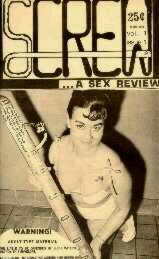
Investing $175 apiece, the two men published the first issue of Screw in November 1968: a 12-page Baedeker to the underworld featuring blue-movie reviews, nude photos, a guide to dirty bookstores and a field test by Mr. Goldstein of an artificial vagina.
Although they had difficulty finding a willing distributor for a tabloid whose first cover featured a photograph of a bikini-clad brunette stroking a large kosher salami, Screw’s circulation soon reached 100,000 — or so Mr. Goldstein claimed (it was never audited) — and the magazine stepped up its ambitions.
As quasi-legal, discreetly misnamed “massage parlors” multiplied across the city in the early 1970s, Mr. Goldstein assigned himself to visit and rate each one. He claimed that his early, enthusiastic review of the movie “Deep Throat” helped turn it into hard-core pornography’s first bona fide mainstream hit.
An issue in the 1970s with frontally nude photos of Jacqueline Kennedy Onassis sold more than a half-million copies, Mr. Goldstein said — a fraction of the seven million Playboy sold in those days, but enough to raise Mr. Goldstein’s profile considerably.
With renown came obscenity arrests and lawsuits, which Mr. Goldstein in turn milked for maximum publicity. (He also wrote countless scathing editorials accusing his accusers of hypocrisy, often accompanied by crude photo collages showing them engaged in humiliating sex acts.) Mr. Goldstein, claiming First Amendment protection, beat most of the charges, occasionally paying nominal fines.
In 1973, though, a United States Supreme Court decision made it easier to prosecute pornographers. Before then, one legal test for obscenity was whether a publication was “utterly without redeeming social value.” The 1973 decision broadened the definition to include material that lacked “serious literary, artistic, political or scientific value,” and it empowered communities to set local standards for whether such material was obscene.
This led federal prosecutors to direct some postmasters in Kansas to order copies of Screw. Upon delivery, Mr. Goldstein was charged with 12 obscenity and conspiracy counts and faced up to 60 years in prison.
His lawyers argued that the anticensorship diatribes in Screw made the magazine sufficiently political, though Mr. Goldstein himself ridiculed this defense, insisting that a reader’s erection “is its own redeeming value.” After three years and two trials his conviction in the first was overturned, and the second ended in a hung jury. Mr. Goldstein’s company, Milky Way Productions, paid a $30,000 fine in return for the dropping of personal charges against him and Mr. Buckley.
Mr. Goldstein also won a copyright suit filed by the Pillsbury Company after Screw depicted its signature doughboy in flagrante, and an invasion-of-privacy suit filed by an actress in a cracker commercial that Mr. Goldstein repurposed for “Midnight Blue.”
Screw made Mr. Goldstein rich enough to afford a townhouse down the block from Bill Cosby on the Upper West Side. But as time went on and hard-core pornography became widely available, the magazine seemed less and less radical, and he began losing interest.
“There is a pattern to American life that what is avant-garde becomes commonplace,” Mr. Goldstein said in 1981. “The mass market eventually assimilates that which is innovative or revolutionary.”
Mr. Goldstein began a dozen other magazines, with titles like Death, Smut, Cigar and Mobster Times, all of which failed. He bought a mansion in Pompano Beach, Fla., where he made an abortive run for county sheriff in 1992.
Gradually, Mr. Goldstein’s empire declined. The Village Voice and other newspapers, many of them free, siphoned off the ads for escort services that were Screw’s mainstay. Mr. Goldstein failed to stake out strong positions in the booming sectors of video and Internet pornography.
Meanwhile, his vendettas came to seem more petty and personal. He was convicted in 2002 of harassing a former secretary in the pages of Screw, though that conviction, too, was overturned. After his son, Jordan, disinvited him to his graduation from Harvard Law School, Mr. Goldstein published doctored photos showing Jordan having sex with various men and with his own mother, Mr. Goldstein’s third ex-wife, Gena.
Mr. Goldstein eventually married five times. His survivors include his son. Mr. Goldstein was long estranged from his fifth wife, Christine.
In quick succession starting in 2003, Mr. Goldstein lost his company, his Florida mansion and a series of subsistence jobs in New York, including one as a greeter at the Second Avenue Deli. In 2004, while living in a homeless shelter, he was arrested and charged with stealing books from a Barnes & Noble store.
His long decline found him bouncing from his in-laws’ floor in Queens to Veterans Affairs hospitals to a cramped apartment in Staten Island paid for by his friend, the magician Penn Jillette, to the Brooklyn nursing home where he spent most of his final years.
There were some late bright spots, though. He was briefly a star catering salesman for a Manhattan bagel store. He blogged for Booble, a website devoted to the pornography business.
And at age 69, he was nominated for best supporting actor at the Adult Video News Awards for his age-defying role in “Al Goldstein & Ron Jeremy Are Screwed.”
“Only in America,” Mr. Goldstein said.