Thursday, August 25, 2011

1 million dead in 30 seconds


In an increasingly urbanized world, earthquakes threaten unprepared cities with mass destruction
By Claire Berlinski CHICAGO TRIBUNE
Seismic risk mitigation is the greatest urban policy challenge that the world confronts today. If you consider that too strong a claim, try to imagine another way in which bad urban policy could kill 1 million people in 30 seconds. Yet the politics of earthquakes are rarely discussed, and when discussed, widely misunderstood. Take the Great East Japan Earthquake on March 11, which released 600 million times the energy of the Hiroshima bomb. The ensuing partial meltdown of the Fukushima reactor prompted international hysteria about nuclear power, but few seemed to realize that a far deadlier threat had been averted. As seismologist Roger Bilham has aptly put it, houses in seismically active zones are the world's unrecognized weapons of mass destruction — and Japan's WMDs didn't go off. Its buildings — at least those that weren't swept away by the accompanying tsunami, a force of nature against which we are still largely helpless — remained standing, and the people inside survived.


That so few buildings collapsed in the earthquake was a human triumph of the first order. It showed that countries can make great progress in seismic risk mitigation; in the Kobe earthquake of 1995, 200,000 buildings collapsed. But cities around the world seem happy to ignore the earthquake threat — one that is only growing as the cities themselves get bigger and bigger.

And the odds are …
In January 2010, an earthquake struck Haiti and destroyed nearly 100,000 buildings. Hospitals, schools, government buildings, jails, hotels, churches, whole neighborhoods — all crumbled, entombing everyone inside. After the quake, I received an email from a scholar of international relations. "It's odd that earthquakes tend to occur frequently in countries that can least afford them," she wrote.
You could only write such a sentence if you had never given the matter much thought. It isn't odd; in fact, it isn't true. Mother Nature doesn't have it in for the poor. Rather, earthquakes come to our attention only when they are disasters, and they are disasters only when they strike dense urban areas full of badly made buildings. Last year, there were a number of earthquakes larger than the one that leveled Port-au-Prince, but they didn't make the news because they happened in the middle of nowhere. California's Loma Prieta quake, the "World Series earthquake" of 1989, was as big as the one in Port-au-Prince. It killed so few people by comparison — 63 — because San Francisco's buildings and infrastructure were well-designed and strong.

In the wake of the Kobe quake, Japanese engineers took extensive measures to reinforce buildings and infrastructure. They installed rubber blocks under bridges. They spaced buildings farther apart to prevent domino-style tumbling. They introduced extra bracing, base isolation pads, hydraulic shock absorbers. A minute before the March earthquake, automatic seismic monitoring systems sent warnings to Japanese cellphones. Elevators glided obediently to the nearest floor and opened. Surgeries were halted. Videos from Tokyo show skyscrapers swaying gracefully, like cornstalks in the wind. Not one collapsed.

Likewise, the aftershock that struck Christchurch, New Zealand, in February was deadly, but the astonishing part of that story isn't that several of the city's buildings collapsed; it's that most of them did not. The peak ground acceleration — a measurement of how much the ground shakes — was immense, one of the highest ever recorded. Something like that would have flattened most cities. New Zealand's strict and well-enforced building codes saved Christchurch from annihilation.

But many of the world's biggest cities are built more like Port-au-Prince, and many are at massive seismic risk. Eight of the world's 10 biggest cities are built on fault lines. There is a reason for this: People like to live near water and fertile ground. Over the millenniums, seismic activity creates coasts, valleys that channel water, temperate microclimates. The human mind doesn't work on geologic time, so people rarely ask themselves how exactly these attractions came into being.


The odds of more Haiti-scale destruction are growing by the day because the world is urbanizing. Two hundred years ago, Peking was the only city in the world with a population of 1 million people. Today, almost 500 cities are that big, and many are much bigger. That explains why the number of earthquake-caused deaths during the first decade of this century (471,015) was more than four times greater than the number during the previous decade, according to statistics compiled by the U.S. National Earthquake Information Center. If the fatality trend continues upward — and it will because the urbanization trend is continuing upward, as is the trend of housing migrant populations in death traps — it won't be long before we see a headline announcing 1 MILLION DEAD IN MASSIVE EARTHQUAKE. Indeed, we'll be lucky not to see it in our lifetimes.


We know which cities are most at risk: Bogota, Cairo, Caracas, Dhaka, Islamabad, Istanbul, Jakarta, Karachi, Katmandu, Lima, Manila, Mexico City, New Delhi, Quito and Tehran. Los Angeles and Tokyo are prime candidates for a major quake, but they will probably survive because they are well-built — though LA could do better. New York is at greater risk than people realize. In 2008, researchers at Columbia University's Lamont-Doherty Earth Observatory published a paper in the Bulletin of the Seismological Society of America noting, among other things, that the Indian Point nuclear power plant was sitting on top of two active seismic zones. The odds of a quake big enough to cause a Fukushima-like disaster there are small. The odds of a quake big enough to take down houses constructed under pre-1995 building codes are not.


Why the attitude?


So we understand enough about seismology to be sure that certain cities face a high risk of earthquakes with enormous death tolls, and we understand enough about engineering and disaster management to say exactly what should be done to protect the residents of those cities. What we don't understand — or rather, what we're seldom willing to say plainly — is why some governments take the risk seriously and take aggressive steps to mitigate it, while others shrug and say, Que sera, sera.


It's tempting to think that people in certain countries are cavalier about the risk because they're poor. The argument goes like this: Safe houses cost more to build than cheap ones do. Cement watered down with sand stretches further. People in poor cities don't have the money to build safe houses; or if they do, they have decided to use it to mitigate more immediate risks. Before the earthquake in Haiti, it certainly wasn't possible to say that the odds of a catastrophic quake were 100 percent; the odds, however, that a substantial percentage of the population would die prematurely of malnutrition and preventable childhood disease were 100 percent. No one there could have been persuaded, before the earthquake, to prioritize sound building construction over food.


If wealth were all there were to it, the solution to the problem would be, if not simple, at least obvious. To prepare for an earthquake, promote economic development and cross your fingers. When your country becomes wealthy enough, the problem will solve itself. If we followed this argument to its natural end, we would conclude that the best seismic risk reduction strategy is market liberalization, the reduction of the state sector and a growth-oriented economic policy that aims to expand the middle class as quickly as possible. In a diversified, developed economy, so this logic goes, private actors will promote earthquake safety and will do so more efficiently than the government. Insurers will not insure improperly retrofitted buildings. Businesses will safeguard their investments by demanding that they be housed in structurally sound buildings. And middle-class people will have the good sense to demand, build and live in properly retrofitted buildings, since nobody wants to die in an earthquake. Other policy recommendations would follow: For example, don't press for heavy-handed zoning laws or further regulation of the construction industry because regulation, as every economist knows, imposes economic costs, and any drag on growth is the last thing you need in an economic race against time.


This theory has been voiced in Istanbul, where I live. Mustafa Erdik, chairman of the department of earthquake engineering at Bogazici University, has suggested that Turkey's best hope is rapid economic growth. If it happens fast enough, he prays, property owners will be able to replace the worst housing stock before the ground starts shaking. If we look at it this way, we see seismic risk reduction as a paradox: The best way to reduce the risk is to ignore it.


The idea is tempting and elegant. But it's wrong.


Where trouble begins


Wealth, in and of itself, is not enough to get people to take earthquakes seriously. Here is the evidence. On Feb. 27, 2010, an earthquake measuring 8.8 on the Richter scale struck near Concepcion, Chile. While the epicenter was not at the heart of the city, this quake was 100 times bigger than the one that leveled Port-au-Prince. It was so massive that it shortened the length of the day by 1.26 microseconds and moved the Earth on its axis by 8 centimeters. When it was over, the entire city of Concepcion had been moved 3 yards to the west.


The death toll from this monster was 521. Each death was its own disaster, of course, but the number was nevertheless astoundingly small for an earthquake that, by all rights, should have destroyed Chile as a whole. So minimal was the damage that Chileans rejected all offers of foreign aid. Chile did so well because its building codes are some of the strictest and most advanced in the world and because the codes do not merely exist on paper — they are enforced.


Now consider Turkey. There is not a geologist alive who doubts that a major earthquake is likely to hit Istanbul soon. In 2000, the U.S. Geological Survey put the odds of its happening within 30 years at 62 percent; other survey teams give it 70 percent. Erdik has estimated that it will kill between 200,000 and 300,000 people. The cost of the cleanup — $50 billion would be an optimistic estimate — will surely set Turkey's economy back decades. It will be a political cataclysm, with massive ramifications for the entire region.


Every day, I walk past buildings in Istanbul that are clearly unsound. I see ground floors, for example, with walls or columns removed to make way for store displays, violating one of the most important principles of earthquake-resistant construction. There are vast neighborhoods filled with illegal, flimsy structures called "gecekondu," which means "landed overnight." The gecekondu, which range from crude shanties to concrete multistory apartment blocks, house hundreds of thousands of rural migrants who have come to Istanbul seeking work over the past decade. Gecekondu aren't built by engineers. They tend to be built on bad soil. They are packed with children.


Even buildings approved by engineers, warned a recent study by the Turkish Chamber of Civil Engineers, are largely not built to code; only half are earthquake-proof. The chamber also warned that 86 percent of the city's hospitals were at high risk of collapse. Turkey's biggest builders have freely admitted to using shoddy materials, such as sea sand and scrap iron, in buildings made of reinforced concrete. In fact, construction standards here are so lousy that buildings regularly collapse without the aid of an earthquake.


Is it because Turkey is poor? Per-capita gross domestic product in Chile this year is $15,867. In Turkey, it is $14,077. That's not a huge difference.


A bit of common sense


The point becomes even clearer if we consider "nonstructural seismic risk mitigation" — the little things, besides building better houses, that people can do to protect themselves. These steps aren't expensive. For example, according to studies done by the Istanbul Seismic Risk Mitigation and Preparedness Project, a quake of the size widely predicted would rupture 30,000 natural gas lines. In the aftermath of a stressful event, people do a predictable thing: They smoke. Smoking near a ruptured gas line is a good way to start a fire. But I don't think I've ever seen a sign or TV commercial anywhere in Istanbul saying, "If it happens, don't light up."


While it is very expensive to tear down and replace or reinforce inadequate housing, it isn't expensive at all to bolt heavy goods to the walls or to move heavy furniture away from beds. Rarely is this done in Istanbul. The odd thing is that everyone does fear the coming quake. Last year, a minor jolt panicked the city and sent the Turkish word for earthquake, "deprem," to the top of Twitter's trending topics, but almost no one knows what to do if it happens, or cares to know. I know many people in Istanbul who are wealthy enough to live in safer buildings but don't. They are fully aware of the risk. When asked why they don't do anything about it, they shrug. They're fatalistic. Most Turks think day to day, not long term.


Contrast Turkey with Japan, where "there's no such thing as an honest mistake," as one American who has lived puts it. "Every mistake is a moral failure. In other words, you should have worked harder, you should have prepared better, you should have been more careful. So even their (emergency) practice drills have to be rehearsed. Everybody has practiced." After the March quake, journalist Kirk Spitzer, who lives in Japan, wrote about the culture of earthquake preparedness there: "Our shelves are lined with rubberized material to keep glasses and plate-ware from sliding; nothing fell over and broke, not even delicate champagne glasses we brought from Paris. Elsewhere, floor-mounted latches kept bedroom and hallway doors from slamming or breaking loose. Picture rails built into the ceiling kept even heavy frames from crashing to the floor."


Ordinary, middle-class Japanese people take these steps to protect their drinking glasses. Many museums in Istanbul fail to take similar steps to protect priceless sculptures, ceramics and cuneiform.


You see a similar failure to turn worry into action at the governmental level. Local officials in the municipality of Besiktas have elaborate earthquake plans — they showed them to me in a PowerPoint presentation. But they exist only on PowerPoint, where they have existed since 2008 without any progress made toward implementation.


Fatalism kills. Short-term thinking kills. But above all, corruption kills. On the anniversary of the Haiti earthquake, Nicholas Ambraseys and Roger Bilham published an extraordinary study in Nature where they determined that 83 percent of all deaths from building collapses in earthquakes in the last 30 years took place in countries that were "anomalously corrupt" — that is, in countries that were perceived to be more corrupt than you would predict from their per-capita income.


Economist Charles Kenny's definitive 2007 study argues persuasively that the construction industry is the most corrupt sector of the world economy. And the more corruption there is in construction — whether it consists of companies using substandard materials or of governments granting permission to build in zones unsuitable for habitation — the likelier you are to die. In China, the buildings that crumble during earthquakes are schools and hospitals, while the party's headquarters and the houses of its functionaries remain standing.


Spin the wheel …


When the Haiti earthquake struck last year, I had a personal reason to be alarmed: My brother and his family lived in Port-au-Prince. They survived, but many of my sister-in-law's co-workers were crushed to death. From Washington, D.C., I translated text messages sent to an emergency number set up to help search-and-rescue teams locate victims. The messages were awful: "To anyone in the Mont-Joli-Turgeau area. ... Jean-Olivier Neptune is caught under rubbles of his fallen house. ... He is alive but in very bad shape." "Please anyone let me know if my uncle Dr. James Plantin who resides in Jacmel is OK. … He is not answering the phone." "Hotel Montana at Rue Franck Cardozo in Petionville collapsed. 200 feared trapped."


A quarter of a million people were killed in Haiti, and God knows how many more were maimed, physically and emotionally, by collapsing buildings. This will happen again and again, in larger and larger numbers.


Spin the wheel: Bogota, Cairo, Caracas, Dhaka, Islamabad, Istanbul, Jakarta, Karachi, Katmandu, Lima, Manila, Mexico City, New Delhi, Quito, Tehran. It will be one of them. It isn't too late to save them. But we need to say the truth about why they're at risk in the first place.


Claire Berlinski, a City Journal contributing editor, is an American journalist who lives in Istanbul. Reprinted with permission from the City Journal.




Tuesday, August 23, 2011

Hurricane Irene marks 1st big US threat in years


By CURT ANDERSON Associated Press

MIAMI—The rapidly intensifying Irene that's already cut a destructive path through the Caribbean is the first hurricane to seriously threaten the U.S. in almost three years, a worry for some emergency management officials who hope people haven't become complacent about the dangers.
Predictions by the U.S. National Hurricane Center in Miami said Irene was likely to become a major Category 3 hurricane Tuesday. By Thursday as it roars toward the U.S. coast over warm open waters, it could become a Category 4, NHC hurricane specialist John Cangialosi said late Monday. Winds in such a storm can blow from 131 to 155 mph (210-249 kph).
For now, the first Atlantic hurricane of the season had maximum sustained winds early Tuesday around 100 mph (160 kph) and it could land in Florida, Georgia or South Carolina. The last hurricane to make landfall in the U.S. was Ike, which pounded Texas in 2008.

Bryan Koon, director of the Florida Division of Emergency Management, said after a meeting Monday with Gov. Rick Scott that the two have frequently discussed raising awareness since the Atlantic hurricane season began June 1 and is still predicted to be active.

"We want to make sure Floridians are paying attention," Koon said. "We are at the height of the hurricane season right now. If it's not Hurricane Irene, it could be the follow-up storm that impacts us."

After several extremely active years, Florida has not been struck by a hurricane since Wilma raked

across the state's south in October 2005. The Hurricane Center said it was responsible for five deaths in the state and came two months after Hurricane Katrina devastated New Orleans.
"For residents in states that may be affected later this week, it's critical that you take this storm seriously," said Craig Fugate, administrator at the Federal Emergency Management Agency.
Julio Gonzalez in Miami was heeding the warnings and headed to a hardware store to pick up what he needed to protect his home.
"I'm gonna board up," he said Monday. "It's best to play it safe."
Others were stocking up on bottled water and plywood. And Hurricane Irene was trending on Twitter.
The storm slashed directly across Puerto Rico, tearing up trees and knocking out power to more than a million people. It then headed out to sea, north of the Dominican Republic, where the powerful storm's outer bands were buffeting the north coast with dangerous sea surge and downpours. President Barack Obama declared an emergency for Puerto Rico, making it eligible for federal help.
Irene was forecast to pass over or near the Turks and Caicos Islands and the southeastern Bahamas by Tuesday night and be near the central Bahamas early Wednesday.
In the overseas U.K. territory of the Turks and Caicos, a steady stream of customers bought plywood and nails at hardware stores, while others readied storm shutters and emergency kits at home.
"I can tell you I don't want this storm to come. It looks like it could get bad, so I've definitely got to get my boats out of the water," said Dedrick Handfield at the North Caicos hardware store where he works.
Many of the center's computer models had the storm veering northward away from Florida's east coast toward Georgia and the Carolinas, but forecasters said much was still unclear.
"In terms of where it's going to go, there is still a pretty high level of uncertainty," said Wallace Hogsett, a National Hurricane Center meteorologist. "It's a very difficult forecast in terms of when it's going to turn northward."
One key reason for that, he said, is the difficulty of measuring the effect on Irene of the high terrain of the island of Hispaniola, which is shared by Haiti and the Dominican. Hurricane warnings were up on the northern side of the Dominican Republic, as well as the Turks and Caicos islands just south of the long Bahamas chain. Forecasters say it depends on which way the storm veers after passing the Bahamas Tuesday or into Wednesday and heads into the very warm Atlantic waters.
And several past hurricanes have turned into Category 4 or 5 monsters but hit land with much less force.
The other big factor is exactly when the storm will encounter a higher-level trough along the U.S. East Coast, which will eventually turn it to the north.
"Timing is everything," Hogsett said.
In South Carolina, state and coastal emergency agencies went on alert for possibly the first hurricane to hit there in seven years.
"This is potentially a very serious hurricane," longtime Charleston Mayor Joseph P. Riley Jr. said. He led Charleston's recovery from the massive destruction of Hurricane Hugo's 135 mph winds and waves back in 1989.
Joe Farmer of the state Emergency Management Division said he's not worried about complacency.
"If it does move this way, there will be a lot of public notice given and people will be warned," he said.
It's been more than a century since Georgia has taken a direct hit from a Category 3 storm or greater. That was in 1893 and the last hurricane to make landfall along the state's 100-mile coast was David, which caused only minor damage when it struck in 1979.
In Tallahassee and across Florida, emergency management agencies were closely monitoring Irene's movements and track. They urged residents to make sure they have batteries, drinking water, food and other supplies available in case Irene takes aim at the state.
"We must prepare for the worst and hope for the best," said Joe Martinez, chairman of the Miami-Dade County Commission.
Gov. Scott met with state emergency management officials and the state meteorologist, poring over detailed charts involving windspeed and steering currents. Scott, a first-term Republican who has not experienced a hurricane as governor, asked questions such as how much advanced notice would be needed for evacuations of low-lying areas.

"Irene's going to be close," Amy Godsey, the state meteorologist, told Scott. "We're not out of the woods yet."

Scott replied, "I'm an optimist."


———


Associated Press writers Ezequiel Abiu Lopez in Nagua, Dominican Republic, Gary Fineout in Tallahassee and Bruce Smith in Charleston, S.C. contributed to this report.

Wednesday, August 10, 2011

From Andrew sullivan 8/9/11
The Derbyshire-Bartlett Alliance, Ctd

A reader writes:

No. There's no sign the "Tea Party" are actually against government. They're just against government run by anybody except themselves. And since "they" are the rump South, that "anybody" mainly means the feds: the Northerners, the liberals, the carpetbaggers, the negro-lovers -- and of course, worst of all, the negros themselves ("negroes" to include not just African-Americans, but all sub-human others, including gays and, now, Muslims).

You have to remember this is the planter class. The planter mentality. The foundation of the South, and so of this country, when one considers the fortunes of many (most?) of the founding fathers. We have been at war with ourselves from the beginning. 2008 was just one more battle: a nigger (radical, terrorist, illegal alien) up against a son of the South (patriot, military man, scion of the McCains, among the largest slaveholders in Mississippi before the Civil War, still owners of the original plantation "Teoc").

All the Tea Party/Republican/Fox News actions since losing the election have simply been scorched earth warfare: deny the oppressing invader any sustenance, no matter what the cost to the country. Because first things first: destroy the usurper first, the alien, the radical, the invader, the liberal, the fed, the other -- then rebuild once the war is won. That's the game. No, they are not against government, or debt. They're just against any government or debt other than their own.

Tuesday, August 09, 2011

.

What Happened to Obama?
By DREW WESTEN NY TIMES
Drew Westen is a professor of psychology at Emory University and the author of “The Political Brain: The Role of Emotion in Deciding the Fate of the Nation.”


Atlanta

IT was a blustery day in Washington on Jan. 20, 2009, as it often seems to be on the day of a presidential inauguration. As I stood with my 8-year-old daughter, watching the president deliver his inaugural address, I had a feeling of unease. It wasn’t just that the man who could be so eloquent had seemingly chosen not to be on this auspicious occasion, although that turned out to be a troubling harbinger of things to come. It was that there was a story the American people were waiting to hear — and needed to hear — but he didn’t tell it. And in the ensuing months he continued not to tell it, no matter how outrageous the slings and arrows his opponents threw at him.

The stories our leaders tell us matter, probably almost as much as the stories our parents tell us as children, because they orient us to what is, what could be, and what should be; to the worldviews they hold and to the values they hold sacred. Our brains evolved to “expect” stories with a particular structure, with protagonists and villains, a hill to be climbed or a battle to be fought. Our species existed for more than 100,000 years before the earliest signs of literacy, and another 5,000 years would pass before the majority of humans would know how to read and write.

Stories were the primary way our ancestors transmitted knowledge and values. Today we seek movies, novels and “news stories” that put the events of the day in a form that our brains evolved to find compelling and memorable. Children crave bedtime stories; the holy books of the three great monotheistic religions are written in parables; and as research in cognitive science has shown, lawyers whose closing arguments tell a story win jury trials against their legal adversaries who just lay out “the facts of the case.”

When Barack Obama rose to the lectern on Inauguration Day, the nation was in tatters. Americans were scared and angry. The economy was spinning in reverse. Three-quarters of a million people lost their jobs that month. Many had lost their homes, and with them the only nest eggs they had. Even the usually impervious upper middle class had seen a decade of stagnant or declining investment, with the stock market dropping in value with no end in sight. Hope was as scarce as credit.

In that context, Americans needed their president to tell them a story that made sense of what they had just been through, what caused it, and how it was going to end. They needed to hear that he understood what they were feeling, that he would track down those responsible for their pain and suffering, and that he would restore order and safety. What they were waiting for, in broad strokes, was a story something like this:

“I know you’re scared and angry. Many of you have lost your jobs, your homes, your hope. This was a disaster, but it was not a natural disaster. It was made by Wall Street gamblers who speculated with your lives and futures. It was made by conservative extremists who told us that if we just eliminated regulations and rewarded greed and recklessness, it would all work out. But it didn’t work out. And it didn’t work out 80 years ago, when the same people sold our grandparents the same bill of goods, with the same results. But we learned something from our grandparents about how to fix it, and we will draw on their wisdom. We will restore business confidence the old-fashioned way: by putting money back in the pockets of working Americans by putting them back to work, and by restoring integrity to our financial markets and demanding it of those who want to run them. I can’t promise that we won’t make mistakes along the way. But I can promise you that they will be honest mistakes, and that your government has your back again.” A story isn’t a policy. But that simple narrative — and the policies that would naturally have flowed from it — would have inoculated against much of what was to come in the intervening two and a half years of failed government, idled factories and idled hands. That story would have made clear that the president understood that the American people had given Democrats the presidency and majorities in both houses of Congress to fix the mess the Republicans and Wall Street had made of the country, and that this would not be a power-sharing arrangement. It would have made clear that the problem wasn’t tax-and-spend liberalism or the deficit — a deficit that didn’t exist until George W. Bush gave nearly $2 trillion in tax breaks largely to the wealthiest Americans and squandered $1 trillion in two wars.

And perhaps most important, it would have offered a clear, compelling alternative to the dominant narrative of the right, that our problem is not due to spending on things like the pensions of firefighters, but to the fact that those who can afford to buy influence are rewriting the rules so they can cut themselves progressively larger slices of the American pie while paying less of their fair share for it.

But there was no story — and there has been none since.

In similar circumstances, Franklin D. Roosevelt offered Americans a promise to use the power of his office to make their lives better and to keep trying until he got it right. Beginning in his first inaugural address, and in the fireside chats that followed, he explained how the crash had happened, and he minced no words about those who had caused it. He promised to do something no president had done before: to use the resources of the United States to put Americans directly to work, building the infrastructure we still rely on today. He swore to keep the people who had caused the crisis out of the halls of power, and he made good on that promise. In a 1936 speech at Madison Square Garden, he thundered, “Never before in all our history have these forces been so united against one candidate as they stand today. They are unanimous in their hate for me — and I welcome their hatred.”

When Barack Obama stepped into the Oval Office, he stepped into a cycle of American history, best exemplified by F.D.R. and his distant cousin, Teddy. After a great technological revolution or a major economic transition, as when America changed from a nation of farmers to an urban industrial one, there is often a period of great concentration of wealth, and with it, a concentration of power in the wealthy. That’s what we saw in 1928, and that’s what we see today. At some point that power is exercised so injudiciously, and the lives of so many become so unbearable, that a period of reform ensues — and a charismatic reformer emerges to lead that renewal. In that sense, Teddy Roosevelt started the cycle of reform his cousin picked up 30 years later, as he began efforts to bust the trusts and regulate the railroads, exercise federal power over the banks and the nation’s food supply, and protect America’s land and wildlife, creating the modern environmental movement.

Those were the shoes — that was the historic role — that Americans elected Barack Obama to fill. The president is fond of referring to “the arc of history,” paraphrasing the Rev. Dr. Martin Luther King Jr.’s famous statement that “the arc of the moral universe is long, but it bends toward justice.” But with his deep-seated aversion to conflict and his profound failure to understand bully dynamics — in which conciliation is always the wrong course of action, because bullies perceive it as weakness and just punch harder the next time — he has broken that arc and has likely bent it backward for at least a generation.

When Dr. King spoke of the great arc bending toward justice, he did not mean that we should wait for it to bend. He exhorted others to put their full weight behind it, and he gave his life speaking with a voice that cut through the blistering force of water cannons and the gnashing teeth of police dogs. He preached the gospel of nonviolence, but he knew that whether a bully hid behind a club or a poll tax, the only effective response was to face the bully down, and to make the bully show his true and repugnant face in public.

IN contrast, when faced with the greatest economic crisis, the greatest levels of economic inequality, and the greatest levels of corporate influence on politics since the Depression, Barack Obama stared into the eyes of history and chose to avert his gaze. Instead of indicting the people whose recklessness wrecked the economy, he put them in charge of it. He never explained that decision to the public — a failure in storytelling as extraordinary as the failure in judgment behind it. Had the president chosen to bend the arc of history, he would have told the public the story of the destruction wrought by the dismantling of the New Deal regulations that had protected them for more than half a century. He would have offered them a counternarrative of how to fix the problem other than the politics of appeasement, one that emphasized creating economic demand and consumer confidence by putting consumers back to work. He would have had to stare down those who had wrecked the economy, and he would have had to tolerate their hatred if not welcome it. But the arc of his temperament just didn’t bend that far.

The truly decisive move that broke the arc of history was his handling of the stimulus. The public was desperate for a leader who would speak with confidence, and they were ready to follow wherever the president led. Yet instead of indicting the economic policies and principles that had just eliminated eight million jobs, in the most damaging of the tic-like gestures of compromise that have become the hallmark of his presidency — and against the advice of multiple Nobel-Prize-winning economists — he backed away from his advisers who proposed a big stimulus, and then diluted it with tax cuts that had already been shown to be inert. The result, as predicted in advance, was a half-stimulus that half-stimulated the economy. That, in turn, led the White House to feel rightly unappreciated for having saved the country from another Great Depression but in the unenviable position of having to argue a counterfactual — that something terrible might have happened had it not half-acted.

To the average American, who was still staring into the abyss, the half-stimulus did nothing but prove that Ronald Reagan was right, that government is the problem. In fact, the average American had no idea what Democrats were trying to accomplish by deficit spending because no one bothered to explain it to them with the repetition and evocative imagery that our brains require to make an idea, particularly a paradoxical one, “stick.” Nor did anyone explain what health care reform was supposed to accomplish (other than the unbelievable and even more uninspiring claim that it would “bend the cost curve”), or why “credit card reform” had led to an increase in the interest rates they were already struggling to pay. Nor did anyone explain why saving the banks was such a priority, when saving the homes the banks were foreclosing didn’t seem to be. All Americans knew, and all they know today, is that they’re still unemployed, they’re still worried about how they’re going to pay their bills at the end of the month and their kids still can’t get a job. And now the Republicans are chipping away at unemployment insurance, and the president is making his usual impotent verbal exhortations after bargaining it away.

What makes the “deficit debate” we just experienced seem so surreal is how divorced the conversation in Washington has been from conversations around the kitchen table everywhere else in America. Although I am a scientist by training, over the last several years, as a messaging consultant to nonprofit groups and Democratic leaders, I have studied the way voters think and feel, talking to them in plain language. At this point, I have interacted in person or virtually with more than 50,000 Americans on a range of issues, from taxes and deficits to abortion and immigration.

The average voter is far more worried about jobs than about the deficit, which few were talking about while Bush and the Republican Congress were running it up. The conventional wisdom is that Americans hate government, and if you ask the question in the abstract, people will certainly give you an earful about what government does wrong. But if you give them the choice between cutting the deficit and putting Americans back to work, it isn’t even close. But it’s not just jobs. Americans don’t share the priorities of either party on taxes, budgets or any of the things Congress and the president have just agreed to slash — or failed to slash, like subsidies to oil companies. When it comes to tax cuts for the wealthy, Americans are united across the political spectrum, supporting a message that says, “In times like these, millionaires ought to be giving to charity, not getting it.”

When pitted against a tough budget-cutting message straight from the mouth of its strongest advocates, swing voters vastly preferred a message that began, “The best way to reduce the deficit is to put Americans back to work.” This statement is far more consistent with what many economists are saying publicly — and what investors apparently believe, as evident in the nosedive the stock market took after the president and Congress “saved” the economy.

So where does that leave us?

Like most Americans, at this point, I have no idea what Barack Obama — and by extension the party he leads — believes on virtually any issue. The president tells us he prefers a “balanced” approach to deficit reduction, one that weds “revenue enhancements” (a weak way of describing popular taxes on the rich and big corporations that are evading them) with “entitlement cuts” (an equally poor choice of words that implies that people who’ve worked their whole lives are looking for handouts). But the law he just signed includes only the cuts. This pattern of presenting inconsistent positions with no apparent recognition of their incoherence is another hallmark of this president’s storytelling. He announces in a speech on energy and climate change that we need to expand offshore oil drilling and coal production — two methods of obtaining fuels that contribute to the extreme weather Americans are now seeing. He supports a health care law that will use Medicaid to insure about 15 million more Americans and then endorses a budget plan that, through cuts to state budgets, will most likely decimate Medicaid and other essential programs for children, senior citizens and people who are vulnerable by virtue of disabilities or an economy that is getting weaker by the day. He gives a major speech on immigration reform after deporting around 800,000 immigrants in two years, a pace faster than nearly any other period in American history.

THE real conundrum is why the president seems so compelled to take both sides of every issue, encouraging voters to project whatever they want on him, and hoping they won’t realize which hand is holding the rabbit. That a large section of the country views him as a socialist while many in his own party are concluding that he does not share their values speaks volumes — but not the volumes his advisers are selling: that if you make both the right and left mad, you must be doing something right.

As a practicing psychologist with more than 25 years of experience, I will resist the temptation to diagnose at a distance, but as a scientist and strategic consultant I will venture some hypotheses.

The most charitable explanation is that he and his advisers have succumbed to a view of electoral success to which many Democrats succumb — that “centrist” voters like “centrist” politicians. Unfortunately, reality is more complicated. Centrist voters prefer honest politicians who help them solve their problems. A second possibility is that he is simply not up to the task by virtue of his lack of experience and a character defect that might not have been so debilitating at some other time in history. Those of us who were bewitched by his eloquence on the campaign trail chose to ignore some disquieting aspects of his biography: that he had accomplished very little before he ran for president, having never run a business or a state; that he had a singularly unremarkable career as a law professor, publishing nothing in 12 years at the University of Chicago other than an autobiography; and that, before joining the United States Senate, he had voted "present" (instead of "yea" or "nay") 130 times, sometimes dodging difficult issues.

A somewhat less charitable explanation is that we are a nation that is being held hostage not just by an extremist Republican Party but also by a president who either does not know what he believes or is willing to take whatever position he thinks will lead to his re-election. Perhaps those of us who were so enthralled with the magnificent story he told in “Dreams From My Father” appended a chapter at the end that wasn’t there — the chapter in which he resolves his identity and comes to know who he is and what he believes in.

Or perhaps, like so many politicians who come to Washington, he has already been consciously or unconsciously corrupted by a system that tests the souls even of people of tremendous integrity, by forcing them to dial for dollars — in the case of the modern presidency, for hundreds of millions of dollars. When he wants to be, the president is a brilliant and moving speaker, but his stories virtually always lack one element: the villain who caused the problem, who is always left out, described in impersonal terms, or described in passive voice, as if the cause of others’ misery has no agency and hence no culpability. Whether that reflects his aversion to conflict, an aversion to conflict with potential campaign donors that today cripples both parties’ ability to govern and threatens our democracy, or both, is unclear.

A final explanation is that he ran for president on two contradictory platforms: as a reformer who would clean up the system, and as a unity candidate who would transcend the lines of red and blue. He has pursued the one with which he is most comfortable given the constraints of his character, consistently choosing the message of bipartisanship over the message of confrontation.

But the arc of history does not bend toward justice through capitulation cast as compromise. It does not bend when 400 people control more of the wealth than 150 million of their fellow Americans. It does not bend when the average middle-class family has seen its income stagnate over the last 30 years while the richest 1 percent has seen its income rise astronomically. It does not bend when we cut the fixed incomes of our parents and grandparents so hedge fund managers can keep their 15 percent tax rates. It does not bend when only one side in negotiations between workers and their bosses is allowed representation. And it does not bend when, as political scientists have shown, it is not public opinion but the opinions of the wealthy that predict the votes of the Senate. The arc of history can bend only so far before it breaks.

This article has been revised to reflect the following correction:

Correction: August 8, 2011


An earlier version of this essay referred incorrectly to the number of deportations of immigrants during President Obama’s term. Around 800,000 immigrants were deported during his first two years in office; it is not the case that a million immigrants were deported in 2010, the year Mr. Obama gave a speech on immigration reform. Also, a larger number of deportations occurred during the two terms of Mr. Obama’s predecessor, George W. Bush; Mr. Obama has not overseen more deportations than any other president.

Friday, July 15, 2011

US lawmaker wields budget ax over China
By MATTHEW PENNINGTON
The Associated Press

WASHINGTON — A Republican lawmaker is looking to make the Obama administration pay a price for what he sees as its defiance of Congress in pursuing cooperation with China in science and space technology.
A proposal by Rep. Frank Wolf, a fierce critic of Beijing, would slash by 55 percent the $6.6 million budget of the White House's science policy office. The measure was endorsed by a congressional committee this week, but faces more legislative hurdles, and its prospects are unclear.

President Barack Obama has sought to deepen ties with China, which underwrites a major chunk of the vast U.S. national debt and is emerging a challenge to American military dominance in the Asia-Pacific region. Among the seemingly benign forms of cooperation he has supported is in science and technology. Last year NASA's administrator visited China, and during a high-profile state visit to Washington by China's President Hu Jintao in January, the U.S. and China resolved to "deepen dialogue and exchanges in the field of space."

Wolf, R-Va., argues that cooperation in space would give technological assistance to a country that steals U.S. industrial secrets and launches cyberattacks against the United States.

He says Obama's chief science adviser, John Holdren, violated a clause tucked into budget legislation passed this year that bars the White House Office of Science and Technology Policy and NASA from technological cooperation with China. He says Holdren did so by meeting twice with China's science minister in Washington during May.

"I believe the Office of Science and Technology Policy is in violation of the law," Wolf told The Associated Press, adding that cutting its budget is the only response available to him. Wolf chairs a House subcommittee that oversees the office's budget.

The punishment he proposes reflects his deep antipathy toward China, which he accuses of persecuting religious minorities, plundering Tibet and supporting genocide in the Darfur region of Sudan by backing Sudanese President Omar al-Bashir. He described the Obama administration's policy toward the Asian power as a failure and railed against the president for hosting Hu at the White House.

Caught at the sharp end is Holdren's office, whose mandate is to develop sound science and technology policies by the U.S. government and pursue them with the public and private sectors and other nations.

Holdren told a Congressional hearing chaired by Wolf days before his May meetings with Chinese Science Minister Wan Gang that he would abide by the prohibition on such cooperation with China, but then spelled out a rather large loophole: that it did not apply in instances where it affected the president's ability to conduct foreign policy.

At another Congressional hearing shortly afterward, Wolf's annoyance was clear. He threatened to "zero out" Holdren's office.

Space cooperation between the two world powers like the U.S. and the Soviet Union pursued in the Cold War still seems a long way off. NASA Administrator Charles Bolden Jr. visited China in a little-publicized trip in October and discussed "underlying principles of any future interaction between our two nations in the area of human space flight," but no specific proposals.

China sent an astronaut into space in 2003, and plans to send the first building block of a space station into orbit this year, but it still has comparatively limited experience. Another constraint on cooperation is that its manned space program is dominated by its military, whose other capabilities — most clearly demonstrated by a 2007 test that destroyed an orbiting satellite — have alarmed American officials.

But one benefit of basic forms of cooperation, such as sharing data and basic design criteria, could be to learn a little more about China's opaque space program. Since 1999, the U.S. effectively banned use of its space technology by China. That also has a commercial downside for American producers in an increasingly globalized marketplace.

"Renewing civil and commercial space cooperation with China ... is not a blank check and need not provide China with sensitive technologies," wrote James Clay Moltz of the Naval Postgraduate School in testimony at a congressional hearing on China's civilian and military space programs in May.

Wolf has included the prohibition on cooperation with China by NASA and the White House science policy office in the bill approved Wednesday by the House Appropriations Committee. The bill budgets $50.2 billion for a raft of federal agencies involved in law enforcement, trade promotion, space and science for the fiscal year starting in October. The 55 percent reduction faced by the science policy's office far exceeds the overall 6 percent cut in spending across all government agencies covered by the bill.

Holdren's office could not be reached for comment Friday. The bill now goes to the Republican-led House of Representatives for approval. A version also must pass the Democrat-led Senate, and the two bills would have to be reconciled before legislation can be sent to Obama to be signed into law.

___

July 15, 2011 08:46 PM EDT

Copyright 2011, The Associated Press. All rights reserved. This material may not be published, broadcast, rewritten or redistributed.

Inside AJC.COM

Thursday, July 14, 2011

Theodore Roszak, defined 1960s counterculture; 77

By Douglas Martin
New York Times / July 14, 2011

NEW YORK - Theodore Roszak, who three weeks after the Woodstock Festival in 1969 not only published a pivotal book about a young generation’s drug-fueled revolt against authority but also gave it a name - “counterculture’’ - died July 5 at his home in Berkeley, Calif. He was 77.

His wife, Betty, said he had been treated for liver cancer and other illnesses.

Dr. Roszak’s book “The Making of a Counter Culture: Reflections on the Technocratic Society’’ had gone to press months before the music festival was held in August that year, displaying the exuberance and excesses of a generation rebelling against war and seeking new ways to be and think. But in serendipitously timely fashion, the book provided what many regarded as a profound analysis of the youth movement, finding its roots in a sterile Western culture that had prompted young people to seek spiritual meaning in LSD, exotic religions, and even comic books.

“This is a sophisticated Roman candle of a book,’’ the Christian Science Monitor said.

The book contended that science-dominated modern society was ugly, repressive, and soulless; that youthful dissent was coherent enough to be termed a culture; and that this antirationalist “counterculture’’ - a term Dr. Roszak popularized and may have invented - might offer the foundation of a new visionary civilization.

He saw the seeds of a new future in campus rebellions, the civil rights movement, and even a popular button that said, “I am a human being; do not mutilate, spindle, or tear.’’ As he phrased the generation’s quest, “We are outward bound from the old corruptions of the world.’’ Its destination, he said, was “the Holy City.’’

These were themes Dr. Roszak expanded on in a succession of books, most influentially in “Where the Wasteland Ends: Politics and Transcendence in Postindustrial Society,’’ published in 1972. It, like the counterculture book, was a finalist for the National Book Award.

In the New York Times, Anatole Broyard devoted two book review columns to “Wasteland.’’ He called it “nothing less than a State of the Union Message on the condition of the human soul.’’

As Dr. Roszak continued to extol what he saw as new human possibilities, some reviewers questioned his distaste for reason and others his optimism. In reviewing “Unfinished Animal: The Aquarian Frontier and the Evolution of Consciousness’’ in 1975, Pete Hamill said that the luster of the counterculture had by then been extinguished by the shooting of students at Kent State University, Charles Manson’s murderous band, and other traumatic events. The counterculture, Hamill said, had become “just another media fraud.’’

But Dr. Roszak continued to be the generation’s cheerleader, writing a book when the first of the baby boomers reached 50 and several more as they approached old age. He wrote that the idealistic values of the 1960s would inspire millions of baby boomers in their last years.

“The future belongs to age, not youth,’’ Dr. Roszak said in an interview on NBC’s “Today’’ show in 1998.

Dr. Roszak was born in Chicago. His father was a carpenter.

He earned a degree in history from the University of California, Los Angeles, and a doctorate from Princeton. He taught for 35 years at what is now California State University, East Bay, retiring in 1998.

He leaves his wife, the former Betty Greenwald; a daughter, Kathryn Roszak; and a granddaughter.

Dr. Roszak wrote and edited about 20 books, many of which, he said, furthered his reputation as “a leading spokesman for antiscience and as a neo-Luddite crusader.’’

But he preferred to write fiction, which he used to make broad points. In one of his half dozen novels, partly as a comment on sexism, he reimagined Mary Shelley’s classic, Frankenstein, making the narrator not Victor Frankenstein but his half-sister and fiancee. Another tells the tale of a San Francisco-based gay Jewish writer who becomes trapped in a fundamentalist Bible college in Minnesota during a snowstorm.

© Copyright 2011 Globe Newspaper Company.

Wednesday, July 13, 2011

Debt talks grind on, clock ticks toward default
By ANDREW TAYLOR, Associated Press – 2 hours ago
WASHINGTON (AP) — Budget talks between President Barack Obama and his GOP rivals are at a frustrating standstill, leading a top Republican to launch a long-shot proposal to give Obama sweeping new powers to muscle through an increase in the government's debt limit without the approval of a bitterly divided Congress.
Lawmakers return to the White House for another negotiating session Wednesday. A two-hour session Tuesday produced no progress after a day of poisonous exchanges between Democrats and Republicans.
Saying he didn't see a path to an agreement so long as Democrats insist on revenue increases, Senate GOP leader Mitch McConnell of Kentucky offered a backup plan that would, in effect, guarantee Obama requests for new government borrowing authority unless Congress musters veto-proof majorities to deny him.
McConnell's plan immediately ran into stiff opposition among tea party conservatives and seemed unlikely to pass the House, but neither the White House nor House Speaker John Boehner, R-Ohio, dismissed it out of hand.
"I think everybody agrees there needs to be a backup plan if we can't come to an agreement," Boehner said in a Fox News Channel interview Tuesday afternoon. "And frankly, I think Mitch has done good work."
Under McConnell's proposal, Obama could request — and likely secure — increases of up to $2.5 trillion in the government's borrowing authority in three separate installments over the coming year as long as he simultaneously proposed spending cuts of greater size.
The debt limit increases would take effect unless blocked by Congress under special rules that would require speedy action — and even then Obama could exercise his authority to veto such legislation. But the president's spending would have no guarantee of receiving a vote.
"The American people elected (McConnell) to serve as a check on Obama's appetite for out-of-control spending, not to write him a blank check to continue the binge," said conservative activist Brett Bozell. "It's these sort of shenanigans that got Republicans thrown out of power in 2006."
McConnell made his proposal public a few hours before Obama presided over his third meeting in as many days with congressional leaders searching for a way to avoid a default and possible financial crisis.
Democratic officials who participated in the session said Obama did not reject McConnell's idea, but said it's not his preferred approach. A statement issued later by press secretary Jay Carney said the president "continues to believe that our focus must remain on seizing this unique opportunity to come to agreement on significant, balanced deficit reduction."
McConnell's plan was hatched out of frustration that Congress and Obama are deadlocked as the clock ticks toward an Aug. 2 deadline for a market-rattling default on U.S. obligations.
"I had hoped all year long that the opportunity presented by his request of us to raise the debt ceiling would generate a bipartisan agreement that would begin to get our house in order," McConnell said. "I still hope it will. But we're certainly not going to send a signal to the markets and the American people that default is an option."
Republicans are demanding $2 trillion-plus in budget cuts as the price for a commensurate increase in the government's ability to continue to borrow more than 40 cents of every dollar it spends. Both Republicans and Obama see the politically toxic debt limit vote as a way to seize an opportunity to cut future deficits — a move that would seem to be to the political benefit of both sides.
But GOP refusals to consider devoting any new revenue from closing tax loopholes — like those enjoyed by oil and gas companies — to cutting the deficit has led Democrats to withhold further spending cuts beyond a handful tentatively agreed to during several weeks of talks led by Vice President Joe Biden in May and June. For their part, Republicans say the White House is offering minuscule spending cuts in the near term and is pulling back from some tentative agreements on topics like requiring federal workers to contribute more to their pensions.
Obama himself upped the stakes Tuesday, telling CBS News anchor Scott Pelley that more than $20 billion in Social Security checks could be held up.
"I can't guarantee that the checks will go out Aug. 3 if we haven't resolved this," Obama said. "There may simply not be the money in the coffers to do it."
Copyright © 2011 The Associated Press. All rights reserved.

Wednesday, July 06, 2011


Casey Anthony Found NOT GUILTY
By Lizette Alvarez NY TIMES
ORLANDO - Casey Anthony, the young mother whose seeming heartlessness at the disappearance of her daughter transfixed America for three years, was found not guilty yesterday of killing 2-year-old Caylee Marie.

After nearly six weeks of testimony, a jury of seven women and five men decided that Anthony did not murder Caylee by dosing her with chloroform, suffocating her with duct tape, and dumping her in a wooded area, as prosecutors claimed. They did, however, find her guilty of lesser charges, including providing false information to law enforcement officers. The jury did not ask to review any evidence.When the verdict was read, Anthony, 25, who faced a possible death sentence, cried.

The verdict vindicates the defense, which argued from the start that Caylee drowned accidentally in the family swimming pool and that the death was concealed by her panicked grandfather, George Anthony, and his daughter.
It also drove home just how circumstantial the prosecution’s case proved to be. Forensic evidence was tenuous, and no witnesses tied Anthony to her daughter’s death. Investigators found no trace of DNA or solid signs of chloroform or decomposition inside the trunk of Anthony’s car, where prosecutors said Anthony stashed Caylee before disposing of her body.

The prosecution was also hurt because nobody knew how Caylee died; her body was too decomposed to pinpoint a cause of death.All of this allowed Jose Baez, Anthony’s lawyer, to infuse enough reasonable doubt in jurors’ minds to get Anthony acquitted of murder.


“They throw enough against the wall and see what sticks,’’ Baez told the jury, “right down to the cause of death.’’

Caylee was last seen June 16, 2008. Her remains were found six months later in a wooded area near the Anthony home. Despite her daughter’s disappearance, Anthony failed to report Caylee missing for 31 days and created a tangle of lies, including that a baby sitter kidnapped Caylee, to cover up the absence.

The defense conceded Anthony’s lies but said they happened for one reason: She had been sexually abused by her father and had been coached to lie her entire life.
“I told you she was a liar the first day,’’ Baez told the jury.

Despite a vivid portrait of Anthony’s seemingly callous and deceitful behavior after Caylee’s disappearance, jurors decided that the leap from uncaring mother to killer proved too much.
Prosecutors argued that Anthony killed her child so she could carouse with her boyfriend, go clubbing, and live the “bella vita’’ - beautiful life - as her tattoo, done after Caylee’s disappearance, proclaimed.

“Whose life was better without Caylee?’’ Linda Drane Burdick, one of the prosecutors, asked jurors. “That’s the only question you need to answer in considering why Caylee Marie Anthony was left on the side of the road dead.’’With that, Drane Burdick ended her closing statement with a dramatic flourish, leaving behind a split screen image: One side was a photograph of the tattoo, the other was of a smiling Anthony partying with friends after Caylee’s death.
One prosecutor, Jeff Ashton, called it absurd that Anthony’s father, a former homicide detective, would find Caylee dead in the swimming pool and, rather than call 911, cover up the drowning, wrap dead Caylee’s face with duct tape, and dump her body.
“It is a trip down a rabbit hole into a bizarre world where men who love their granddaughters find them drowned and do nothing,’’ Ashton said. “Where men who love their granddaughters take an accident, a completely innocent act, and make it look like a murder for no reason.’’

With Caylee’s grandparents in the back of the courtroom, prosecutors spoke forcefully about the pain the grandparents felt when they realized Caylee was missing and their daughter was the chief suspect. Anthony’s father grew so despondent after the death that he attempted suicide in 2009, leaving behind an eight-page suicide note.
George Anthony, who had testified tearfully during the trial, denied abusing his daughter Casey and denied finding Caylee floating in the pool.
As for motive, prosecutors said Caylee’s murder was hastened by the fact she was beginning to string together words and would soon be able to reveal her mother’s lies.Prosecutors also used jailhouse recordings of Anthony and photographs of her reveling with friends to show she was clearly not grieving for a daughter who had supposedly drowned.

Baez did little to bolster his initial defense during the trial, but he successfully hammered away at the relatively weak forensic evidence.

Sunday, July 03, 2011


Tenderloin gets trendy, apparently on the way up

C.W. Nevius

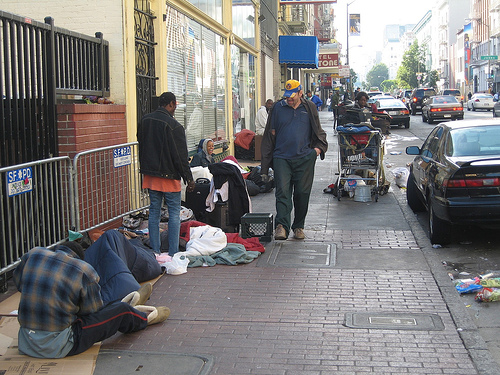
The Tenderloin and environs have been called many things, including dangerous, dirty and unmanageable. But lately locals are rolling out an unlikely new term - trendy.

The anecdotal evidence is the number of young hipster types roaming the streets with snap brim fedoras, Chrome-brand messenger bags and fixie bikes. But the real barometer of change can be found in the storefronts.

Cult coffee shops, quirky eating places and designer cocktail bars have not only set up shop, they're thriving. Kinani Ahmed opened Jebena, his coffee and tea place on Polk, a year ago. Doubters looked at his menu - featuring more than 60 types of loose-leaf tea - and asked him if he knew what neighborhood he was in.

"People actually thought I was crazy," he said. "But we are seeing more of a young crowd now, a coffee-savvy crowd."

Ahmed has a prediction. The area around the Tenderloin, he says, "is becoming the next Mission."

That's not as far-fetched as it sounds. The young crowd moved to the Mission for the cheap rent, gritty vibe and innovative restaurants. Check, check and check in the new Tenderloin area.

"The Mission is too expensive," said Alex Kladitler, who moved to the Tenderloin three months ago. "This is one of the few places where you can afford a studio apartment. I like it here. It's entertaining, and it's safe enough."

If anything, the newcomers celebrate the grit. Brenda Buenviaje opened Brenda's, her Cajun Creole restaurant on Polk above the Civic Center in 1997. There was such demand for crawfish beignets and watermelon iced tea that she expanded and opened a new dining room.

"I got a little flak that the room was too neat," said the New Orleans native. "I feel like the expectation here is that they expect a little funky."

Let's be clear, this is no theme park. This month David Williams will celebrate his first anniversary at Hooker's Sweet Treats. Who knew you'd need to go to lower Hyde to score some awesome hand-dipped, sea-salted caramel candies? But there have been a few Tenderloin moments, like the woman who hit Williams in the face with her purse. That began when he asked her to move along.

"You're just hassling me because I'm black," the woman said.

"No, it's because you're smoking crack in my front door," Williams replied.

Certainly the Turk and Golden Gate corridors near Market are no-go zones. A good rule of thumb is to stay above Ellis, an area known as the "Tendernob," because it creeps up toward Nob Hill.

"People try to say it is kind of Nob Hill. But no, actually it is the Tenderloin," said Jordan Langer, a partner and general manager of Jones, a dinner and custom cocktail spot with a huge rooftop deck on Jones Street, just off Geary.

Jones, which opened in February, is almost too cool for the Tenderloin. Mixed drinks are $10, there's an extensive list of wines - none of them Thunderbird - and the place has such an insider vibe that there's only a small sign next to the entrance. But last Saturday, Langer says, they had more than 1,000 customers, including the dinner and drinks crowd, with 800 for cocktails after 10 p.m.

So there is a market for a high-end foodie experience. If you go to Brenda's, which doesn't take reservations, expect to wait 20 minutes to an hour. But having that much traffic in the area has improved the street - even if crack dealers use her storefront lights to sort product. It is all part of the urban adventure.

"There's a certain charm to parking your car and wondering if it will be broken into," Langer says.
If that sounds charming, head down to the 'Loin. If not, just wait.
It seems, after all the attempts to improve the neighborhood, we may have finally hit on some effective agents of change. The surprise is they turned out to be hand-poured coffee, praline shortbread cookies and Cajun gumbo.

C.W. Nevius' column appears Tuesday, Thursday and Saturday. E-mail him at cwnevius@sfchronicle.com.